Fukushima: Local Specialties, Souvenirs, Shrines & Temples, Sightseeing | Japan 47 Prefecture Guide
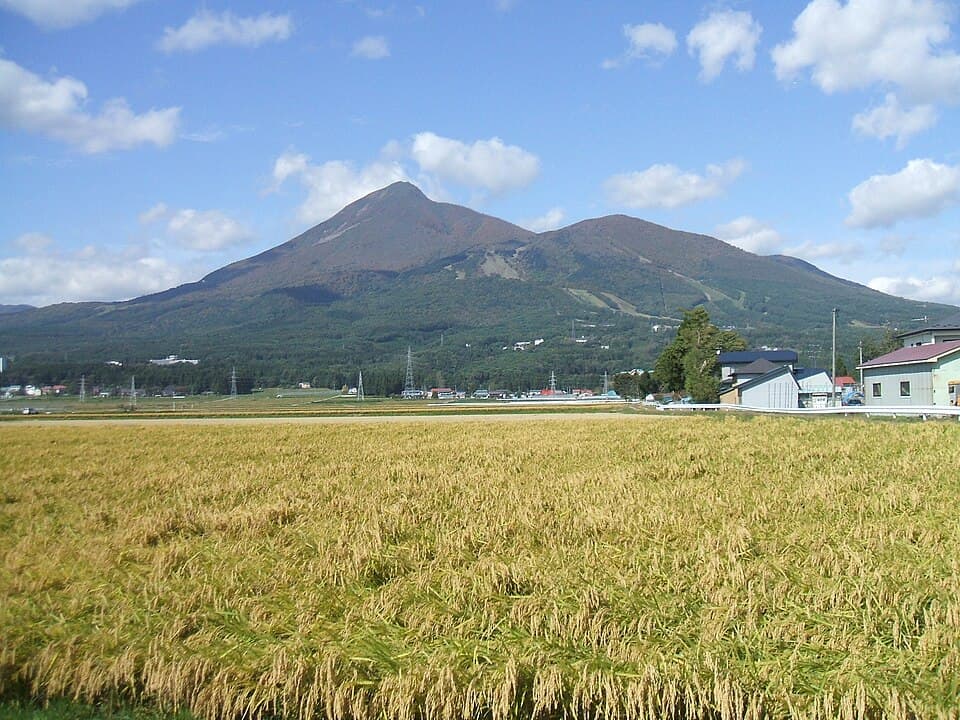
Fukushima holds three different regions inside one prefecture. From the west: Aizu, Nakadori, Hamadori. Mountain ranges divide them, and climate, food and crafts differ across the lines.
Local Specialties
Fukushima is among the top peach growers in Japan. The area around the city of Fukushima in Nakadori is called the Fruit Line, where peaches, pears, grapes and cherries follow one another through the seasons.
In sake, the prefecture has taken first place nationally for gold medals at the Annual Japan Sake Awards, several years running.
That is not chance. It is credited to the prefecture's own brewing academy at its technology centre, which has sent trained brewers back to the breweries. Skill does not improve on its own.
Aizu Koshihikari rice and Shirakawa soba are also known across the country.
Souvenirs
Anpo-gaki is astringent persimmon smoked with sulphur and dried. The inside stays soft, like jelly, which sets it apart from ordinary dried persimmon. It was invented here in the Taisho era.
Milk sweets in silver foil, usukawa manju, and the akabeko. The akabeko is a folk toy said to ward off epidemic disease, and its head sways as you touch it.
Sacred Sites | Shrines & Temples
Shiramizu Amidado and Shojoji and Shiramizu Amidado holds National Treasures. 30 shrines and temples worth knowing in Fukushima.
Isasumi Jinja(Aizumisato)Shinto shrine / Ichinomiya (first shrine) of Iwashiro Province / Aizu / Blessings: warding off misfortune, good harvests
The shrine that carries the origin of the place name Aizu. It has long been held to be the tutelary shrine of the whole region.
Sazaedo(Aizuwakamatsu)Buddhist temple / Important Cultural Property / Aizu / Blessings: warding off misfortune
A double helix in which the way up and the way down never meet. A practical idea, that worshippers should not have to pass one another, produced a wooden building that is rare anywhere in the world.
Ioji(Fukushima)Buddhist temple / Historic Site / Nakadori / Blessings: warding off misfortune
The funerary temple of the Sato family, and known as a temple Basho visited on the Narrow Road to the Deep North.
Nanko Jinja(Shirakawa)Shinto shrine / Nakadori / Blessings: study and exams, good fortune
It enshrines Matsudaira Sadanobu, lord of the Shirakawa domain. It adjoins Nanko Park, held to be the oldest public park in Japan, which Sadanobu opened to people of every rank.
Enzoji(Yanaizu)Buddhist temple / Aizu / Blessings: warding off misfortune, long life
It stands on a cliff above the Tadami river, and carries the legend of the origin of the akabeko.
Shiramizu Amidado(Iwaki)Buddhist temple / National Treasure / Historic Site / Hamadori / Blessings: rebirth and renewal, warding off misfortune
The only National Treasure building in Fukushima. Ringed by the pond of a Pure Land garden, it shows that the cultural sphere of Hiraizumi reached as far as the coast.
Iimoriyama(Aizuwakamatsu)Buddhist temple / Aizu / Blessings: rebirth and renewal
Where the Byakkotai took their own lives. The Sazaedo stands on this hill.
Amidaji(Aizuwakamatsu)Buddhist temple / Aizu / Blessings: rebirth and renewal
The temple where the dead of the Aizu war were buried. The third storey of Tsuruga Castle was moved here.
Nyohoji(Koriyama)Buddhist temple / Nakadori / Blessings: warding off misfortune
An old temple at the centre of Koriyama.
Kaiseizan Daijingu(Koriyama)Shinto shrine / Nakadori / Blessings: good fortune
Called the Ise of the north. It was built alongside the reclamation of the Asaka plain.
Yumoto Onsen Jinja(Iwaki)Shinto shrine / Hamadori / Blessings: long life
The shrine that records the first welling up of Iwaki Yumoto, sometimes counted among the three oldest springs of Japan.
Soma Nakamura Jinja(Soma)Shinto shrine / Important Cultural Property / Hamadori / Blessings: victory
The shrine from which the Soma Nomaoi sets out. The festival is an Important Intangible Folk Cultural Property.
Soma Odaka Jinja(Minamisoma)Shinto shrine / Hamadori / Blessings: victory
The contest for the sacred banners of the Nomaoi is held here.
Hanitsu Jinja(Inawashiro)Shinto shrine / Aizu / Blessings: study and exams, good fortune
It enshrines Hoshina Masayuki, founder of the Aizu domain, and was called the Toshogu of Aizu.
Nakano Fudoson(Fukushima)Buddhist temple / Nakadori / Blessings: warding off misfortune, fire protection
It claims to be one of the three great Fudo halls of Japan, with the Fudo enshrined inside a cave.
Takakura Jinja(Shimogo)Shinto shrine / Aizu / Blessings: warding off misfortune
The tutelary shrine of Ouchi-juku, known for its Hange festival.
Kashima Jinja (Shirakawa)(Shirakawa)Shinto shrine / Nakadori / Blessings: victory
Its deity was invited from Kashima in Hitachi. A shrine guarding the frontier of the north.
Ugajindo(Aizuwakamatsu)Buddhist temple / Aizu / Blessings: wealth
It stands beside the Sazaedo and enshrines figures of the nineteen Byakkotai.
Sazaedo(Aizuwakamatsu)Buddhist temple / Important Cultural Property / Aizu / Blessings: rebirth and renewal
A double-helix ramp. People going up and coming down never pass each other, in a building rare anywhere in the world.
Shojoji(Yugawa)Buddhist temple / National Treasure / Aizu / Blessings: warding off misfortune
Its Yakushi Nyorai and attendant figures are National Treasures, among the finest Heian sculpture in northern Japan.
Byakkotai(Aizuwakamatsu)Utaki (Ryukyuan sacred grove) / Aizu / Blessings: rebirth and renewal
The nineteen who mistook fires in the town below for the castle's fall, and took their own lives, lie here.
Dokutsu(Fukushima)Buddhist temple / Nakadori / Blessings: warding off misfortune
Six Fudo figures are enshrined within the caves.
Fukushima Inari Jinja(Fukushima)Shinto shrine / Nakadori / Blessings: business prosperity
The tutelary shrine of the city of Fukushima.
Nanko Jinja(Shirakawa)Shinto shrine / Nakadori / Blessings: study and exams
It enshrines Matsudaira Sadanobu. Nanko Park is among the oldest public parks in Japan.
Shiramizu Amidado(Iwaki)Buddhist temple / National Treasure / Historic Site / Hamadori / Blessings: rebirth and renewal
The only National Treasure building in Fukushima, standing within a Pure Land garden.
Suzumigaoka Hachiman(Soma)Shinto shrine / Important Cultural Property / Hamadori / Blessings: victory
Its group of shrine buildings is an Important Cultural Property.
Tsurugajo Inari(Aizuwakamatsu)Shinto shrine / Aizu / Blessings: business prosperity
It stood here before Tsuruga Castle was built. It burned with the castle and was rebuilt.
Nihonmatsu Jinja(Nihonmatsu)Shinto shrine / Nakadori / Blessings: warding off misfortune
The lantern festival of Nihonmatsu is one of the three great lantern festivals of Japan.
Hange Matsuri(Shimogo)Shinto shrine / Aizu / Blessings: good harvests
A procession moving through a post town of thatched houses.
Nagatoko(Kitakata)Shinto shrine / Important Cultural Property / Aizu / Blessings: warding off misfortune
An open worship hall where forty-four thick pillars stand in rows. A great ginkgo turns gold before it.
Sightseeing
Breakdown: castle 1, historic townscape 2, hot spring 1, nature / scenery 5. 15 places to see in Fukushima.
Miharu Takizakura(Miharu)nature / scenery / Nakadori / Natural Monument
A weeping cherry said to be more than a thousand years old. One of the three great cherry trees of Japan, and the tree itself has long been revered.
Nakoso no Seki(Iwaki)other / Hamadori
One of the three barriers of the north. A frontier place written into poetry for centuries.
Nisshinkan(Aizuwakamatsu)museum / theatre / Aizu / 1803
The site of the Aizu domain school. The Ju no Okite was the code for the sons of samurai.
Tsuruga-jo(Aizuwakamatsu)castle / Aizu / Historic Site / 1384
It withstood a month-long siege in the Boshin War. A keep with red tiles.
Ouchi-juku(Shimogo)historic townscape / Aizu / Preservation District for Traditional Buildings
Thatched houses line both sides of the road. A post town on the Aizu Nishi Kaido.
Goshikinuma(Kitashiobara)nature / scenery / Aizu
A group of ponds formed by the eruption of Mount Bandai. Each holds water of a different colour.
Lake Inawashiro(Inawashiro)nature / scenery / Aizu
The fourth largest lake in Japan. Called the mirror of heaven, it reflects Mount Bandai.
Miharu Takizakura(Miharu)nature / scenery / Nakadori / Natural Monument
A weeping cherry more than a thousand years old, one of the three great cherry trees of Japan.
Hanamiyama(Fukushima)garden / park / Nakadori
A flower farmer opened his own hillside to the public without charge. A paradise, in Fukushima.
Nanukamachi(Aizuwakamatsu)historic townscape / Aizu
Western-style buildings and storehouses from the Taisho era. The street runs on from Aizu-Wakamatsu station.
Oyakuen(Aizuwakamatsu)garden / park / Aizu / Place of Scenic Beauty / 1696
A daimyo garden where medicinal herbs were grown, laid out around a heart-shaped pond.
Soma Nomaoi(Minamisoma and nearby)festival / event / Hamadori / Important Intangible Folk Cultural Property
Five hundred mounted warriors in full armour. It is said to have run for a thousand years.
Tsuchiyu Kokeshi(Fukushima)industrial heritage / Nakadori
One of the three birthplaces of the kokeshi doll. The patterns are drawn on the lathe.
Abukumado(Tamura)nature / scenery / Nakadori
A limestone cave found during quarrying. It runs 600 metres.
Hawaiians(Iwaki)hot spring / Hamadori / 1966
It was created by turning the hot water and the workforce of a closed coal mine to another use.
Traditional Crafts
Five crafts hold national designation: Aizu lacquerware, Aizu-Hongo ware, Obori-Soma ware, Okuaizu Showa karamushi weaving, and Okuaizu plaited work.
Aizu lacquerware is one of the three great lacquer traditions of Japan, with Yamanaka and Kishu. And Obori-Soma ware has continued even after the earthquake and the nuclear accident forced its potters to evacuate; kilns were opened again wherever they landed.
More: VILLAGE Journal vol.41 — The last of the three great lacquers(リンク先は現在公開されていません)
More from This Prefecture
See all Fukushima articles ← All 47 prefectures
Sources: Ministry of Agriculture, Forestry and Fisheries (Crop Statistics Survey), National Research Institute of Brewing (Annual Japan Sake Awards), Fukushima Prefecture, City of Aizu-Wakamatsu, Aizumisato Town, Agency for Cultural Affairs, Association for the Promotion of Traditional Craft Industries — Value Village editorial team