Ibaraki: Local Specialties, Souvenirs, Shrines & Temples, Sightseeing | Japan 47 Prefecture Guide
Ibaraki has stayed near the top of Japan for agricultural output. The plain is wide, and a huge market sits next door in Tokyo. Those two facts are the industry.
Local Specialties
About 90 percent of Japan's dried sweet potato is made here, concentrated around Hitachinaka and Tokai.
Why this stretch of coast? Dried sweet potato is steamed, sliced, then dried in the sun on the dry winds of winter. There is wind off the sea, little rain, and not too much frost. The conditions were all in place.
Aomori's apples, Yamagata's cherries and Ibaraki's dried sweet potato all say the same thing. A production area is not chosen. The climate decides it.
Melons, lotus root and chestnuts also rank first in Japan. Then there is Mito natto, which came of two things at once: soybean country, and railways that made it possible to send a short-lived food to Tokyo.
Souvenirs
Dried sweet potato is a souvenir as it is. It keeps at room temperature, it is light, and the only ingredient is sweet potato. Preserved food becoming a souvenir is a shape we have seen again and again in this series.
Mito natto, sweets made with plum, and vessels of Kasama ware.
Sacred Sites | Shrines & Temples
Kashima Jingu is the head shrine of Japan's Kashima shrines (about 600 shrines). 27 shrines and temples worth knowing in Ibaraki.
Kashima Jingu(Kashima)Shinto shrine / Ichinomiya (first shrine) of Hitachi Province / One of the Three Shrines of the Eastern Provinces / Important Cultural Property / Rokko / Head shrine of Kashima shrines (about 600 shrines) / Blessings: victory, warding off misfortune, road safety
In Heian-period records, only three shrines could call themselves jingu: Ise, Kashima and Katori. That rank was granted to a place this far from the capital. The kaname-ishi in its grounds is said to pin down the catfish that causes earthquakes.
Ikisu Jinja(Kamisu)Shinto shrine / One of the Three Shrines of the Eastern Provinces / Rokko / Blessings: road safety, safe voyages
With Kashima and Katori, one of the three shrines of the eastern provinces. In the Edo period it was common to visit all three after a pilgrimage to Ise.
Kasama Inari Jinja(Kasama)Shinto shrine / Counted among the Three Great Inari Shrines / Central area / Blessings: business prosperity, good harvests
A ready market of worshippers came first, and that is what pushed Kasama into becoming a pottery town.
Oarai Isosaki Jinja(Oarai)Shinto shrine / Important Cultural Property / Northern area / Blessings: safe voyages, good fortune
Known for the Kamiiso torii standing on a reef in the sea, said to be the rock where its deity came down.
Tsukubasan Jinja(Tsukuba)Shinto shrine / Southern area / Blessings: love and relationships, mountain worship
The two peaks, Nantaisan and Nyotaisan, are themselves the deity. A mountain sung of in the Manyoshu as a place of utagaki courtship gatherings.
Amabiki Kannon(Sakuragawa)Buddhist temple / Important Cultural Property / Western area / Blessings: safe childbirth, warding off misfortune
Known as a Kannon for safe childbirth, and also for the peacocks kept loose in its grounds.
Kashima Okumiya(Kashima)Shinto shrine / Important Cultural Property / Rokko / Blessings: victory
A hall Ieyasu dedicated as the main shrine, later moved to serve as the inner shrine.
Kaname-ishi(Kashima)Utaki (Ryukyuan sacred grove) / Rokko / Blessings: warding off misfortune
A stone said to hold down the head of the catfish that causes earthquakes. Dig as you like, and you never reach its base.
Nyotaisan(Tsukuba)Shinto shrine / Southern area / Blessings: love and relationships, mountain worship
The 877-metre summit, paired with Nantaisan.
Tokiwa Jinja(Mito)Shinto shrine / Central area / Blessings: study and exams, good fortune
It enshrines Tokugawa Mitsukuni and Nariaki, and adjoins Kairakuen.
Kodokan Kashima Jinja(Mito)Shinto shrine / Historic Site / Central area / Blessings: study and exams
It stands inside Kodokan, the school of the Mito domain: a shrine placed where letters and arms were taught.
Hitachi Izumo Taisha(Kasama)Shinto shrine / Central area / Blessings: love and relationships
A shrine whose deity was divided from Izumo Taisha. A great shimenawa rope hangs at its front.
Ushiku Daibutsu(Ushiku)Buddhist temple / Southern area / Blessings: warding off misfortune
A hundred and twenty metres tall, among the largest standing bronze figures in the world.
Ou Jinja(Itako)Shinto shrine / Rokko / Blessings: victory
It carries a tradition of being the original shrine from which Kashima Jingu grew.
Kasama Inari Romon(Kasama)Shinto shrine / Central area / Blessings: business prosperity
A chrysanthemum festival fills the ground before the gate. The entrance to a pottery town.
Yamizomine Jinja(Daigo)Shinto shrine / Northern area / Blessings: mountain worship
It stands on the summit of Mount Yamizo, the highest point in Ibaraki.
Satakeji(Hitachiota)Buddhist temple / Bando 33 Kannon Pilgrimage, Temple No. 22 / Important Cultural Property / Northern area / Blessings: warding off misfortune
The clan temple of the Satake. Its thatched main hall is an Important Cultural Property.
Minato Inari(Hitachinaka)Shinto shrine / Northern area / Blessings: good catches, business prosperity
The faith of a fishing port, rooted in a town that lives by dried sweet potato and the catch.
Shojoji(Koga)Buddhist temple / Western area / Blessings: warding off misfortune
The funerary temple of the Doi, lords of the Koga domain.
Tsukubasan Omido(Tsukuba)Buddhist temple / Bando 33 Kannon Pilgrimage, Temple No. 25 / Southern area / Blessings: warding off misfortune
It stands next to Tsukubasan Jinja, a trace of the old fusion of Shinto and Buddhism.
Sakatsura Isosaki Jinja(Hitachinaka)Shinto shrine / Northern area / Blessings: wealth, good fortune
Paired with Oarai Isosaki Jinja. Known for a belief in winning the lottery.
Kamiiso no Torii(Oarai)Shinto shrine / Northern area / Blessings: good fortune, safe voyages
A torii standing on a rock among the waves. The sunrise falls on it head-on.
Giretsukan(Mito)Shinto shrine / Central area / Blessings: study and exams
It holds materials on the Mito school of thought.
Suigo(Itako)Utaki (Ryukyuan sacred grove) / Rokko / Blessings: good catches, good harvests
A town of iris gardens and waterways. A place that prays for the gifts of water.
Benkei Nanamodori(Tsukuba)Utaki (Ryukyuan sacred grove) / Southern area / Blessings: warding off misfortune
You duck beneath a boulder that looks about to fall. Benkei is said to have turned back seven times.
Oiwa Jinja(Hitachi)Shinto shrine / Northern area / Blessings: good fortune, mountain worship
It enshrines 188 deities, and is known for an astronaut's account of seeing a pillar of light here.
Sojagu (Ishioka)(Ishioka)Shinto shrine / Central area / Blessings: warding off misfortune
It enshrines the deities of Hitachi Province together. The Ishioka festival fills the town.
Sightseeing
Breakdown: historic townscape 1, nature / scenery 1, industrial heritage 3, festival / event 3. 15 places to see in Ibaraki.
Kobuntei(Mito)garden / park / Central area / Historic Site / Place of Scenic Beauty / 1842
A garden open to the people of the domain from the day it was made. Hence the name: pleasure shared.
Seizanso(Hitachiota)museum / theatre / Northern area / Historic Site / Place of Scenic Beauty / 1691
Where Tokugawa Mitsukuni spent his last years and carried on compiling the Dai Nihonshi.
Ryujin(Hitachiota)industrial heritage / Northern area
The name Ryujin Gorge comes from belief in a dragon that governs water.
Kairakuen(Mito)garden / park / Central area / Historic Site / Place of Scenic Beauty / 1842
One of the three great gardens of Japan. It was open to the people of the domain from the start.
Hitachi Seaside Park(Hitachinaka)garden / park / Northern area / 1991
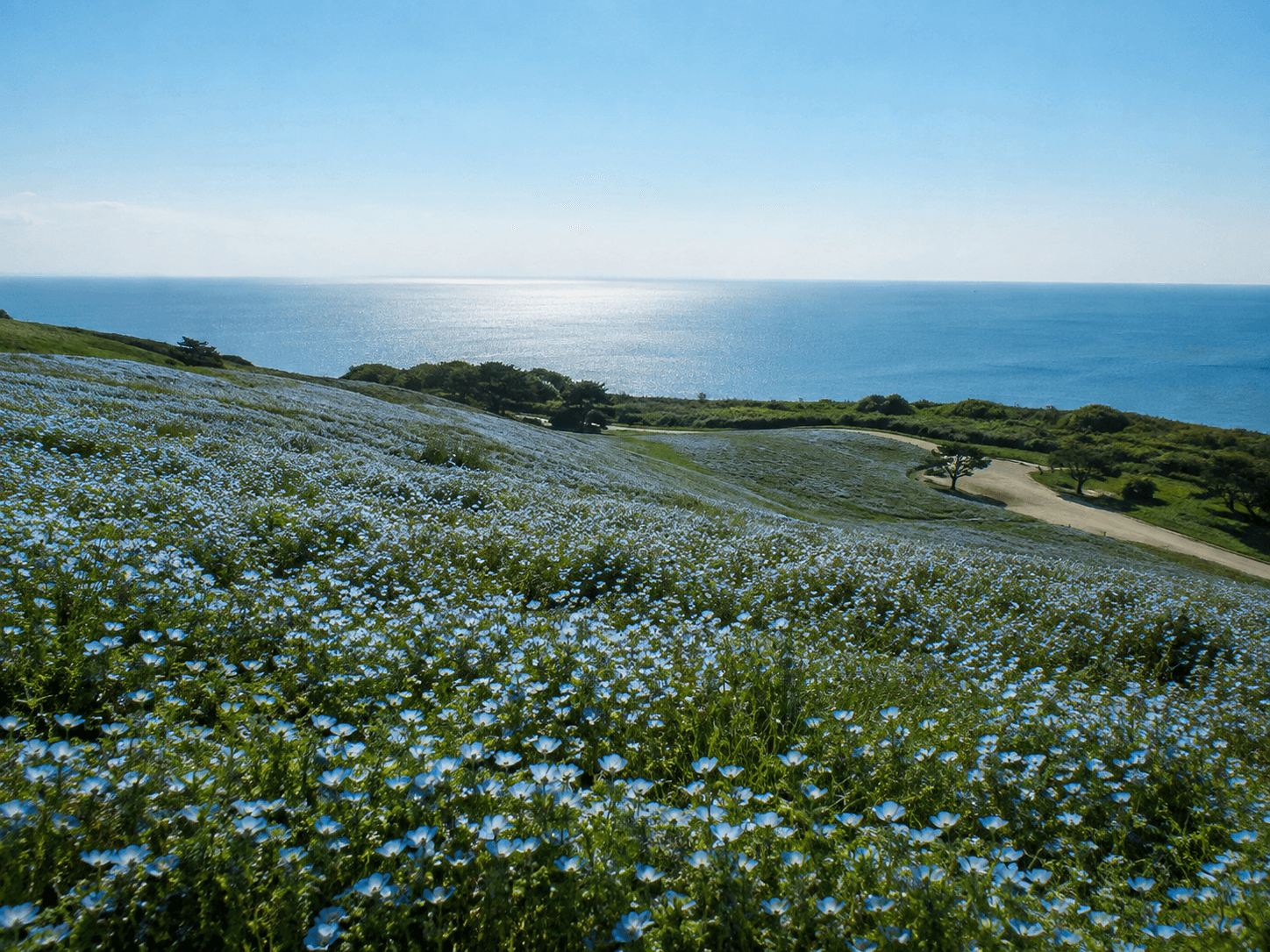
Four and a half million nemophila turn Miharashi Hill blue.
Fukuroda Falls(Daigo)nature / scenery / Northern area / Place of Scenic Beauty
One of the three great waterfalls of Japan. It falls in four stages, hence its other name.
Ushiku Chateau(Ushiku)industrial heritage / Southern area / Important Cultural Property / 1903
Japan's first full-scale winery.
Kodokan(Mito)museum / theatre / Central area / Special Historic Site / Important Cultural Property / Historic Site / 1841
The largest domain school in Japan, teaching letters, arms and medicine as one.
Oarai(Oarai)historic townscape / Northern area
Anglerfish hotpot and whitebait. The port runs on into the seaside park.
Himatsuri(Kasama)festival / event / Central area / 1982
Kasama potters set up their own stalls. One of the largest pottery markets in eastern Japan.
JAXA Tsukuba(Tsukuba)museum / theatre / Southern area / 1972
A full-size H-II rocket lies outdoors.
Yuki Tsumugi(Yuki)industrial heritage / Western area / UNESCO Intangible Cultural Heritage
It uses hand-spun thread. UNESCO Intangible Cultural Heritage.
Itako Ayame(Itako)festival / event / Rokko
A bridal boat moves along the waterway. Five hundred varieties of iris bloom.
Hitachi Furyumono(Hitachi)festival / event / Northern area / Important Intangible Folk Cultural Property / UNESCO Intangible Cultural Heritage
Five-storey floats stage mechanical puppet plays. UNESCO Intangible Cultural Heritage.
Koga Peach(Koga)garden / park / Western area
Two thousand flowering peach trees. They were first planted as a guard against famine.
Traditional Crafts
Three crafts hold national designation: Yuki pongee, Kasama ware and Makabe stone lanterns.
Yuki pongee was inscribed on the UNESCO Intangible Cultural Heritage list in 2010. To qualify, a piece must meet all three conditions: hand-spun thread, hand-tied resist, and the backstrap loom.
More: VILLAGE Journal vol.38 — The pongee that reached UNESCO(リンク先は現在公開されていません)
More from This Prefecture
See all Ibaraki articles ← All 47 prefectures
Sources: Ministry of Agriculture, Forestry and Fisheries (Crop Statistics Survey; Agricultural Income Statistics), Ibaraki Prefecture, City of Mito, Kashima Jingu, Agency for Cultural Affairs, Association for the Promotion of Traditional Craft Industries — Value Village editorial team