Kanagawa: Local Specialties, Souvenirs, Shrines & Temples, Sightseeing | Japan 47 Prefecture Guide
What marks Kanagawa is that a port, an old capital, hot springs and a coastline all fit into a very short distance. That density decides both the food and the crafts.
Local Specialties
The Miura peninsula is daikon and cabbage country. Surrounded by sea, it stays mild through winter, and its strength is that it can ship when other regions are out of season.
Tsumagoi in Gunma uses altitude to ship cabbage in summer. Miura uses mildness to ship in winter. The same vegetable, worked from opposite conditions.
Shonan whitebait has a short season, so raw shirasu is only available part of the year. Ashigara tea is grown in the hills of western Kanagawa.
Souvenirs
Yokohama shumai is made on the assumption that it will be eaten cold, out of a box. It was born as railway station food.
Kamakura's Hato Sable, Odawara kamaboko, and small pieces of Hakone marquetry. If you want a craft as a souvenir, start here.
Sacred Sites | Shrines & Temples
Kotokuin and Engakuji and Engakuji Shariden holds National Treasures. 35 shrines and temples worth knowing in Kanagawa.
Tsurugaoka Hachimangu(Kamakura)Shinto shrine / Important Cultural Property / Kamakura and Shonan / Blessings: victory, warding off misfortune
The town of Kamakura was laid out from this shrine outwards. Wakamiya Oji runs dead straight from the main hall to the sea. The shrine was placed first and the city built to match it, the reverse of Kamigamo and Shimogamo in Kyoto, which were there before the capital. Its deity came from Usa Jingu, and it was here that Hachiman belief spread through the east as the faith of the warrior class.
Samukawa Jinja(Samukawa)Shinto shrine / Ichinomiya (first shrine) of Sagami Province / Kamakura and Shonan / Blessings: warding off misfortune, good fortune
The only shrine in Japan whose deity is said to ward off misfortune from all eight directions, a character without parallel elsewhere.
Hakone Jinja(Hakone)Shinto shrine / Western area / Blessings: good fortune, love and relationships, road safety
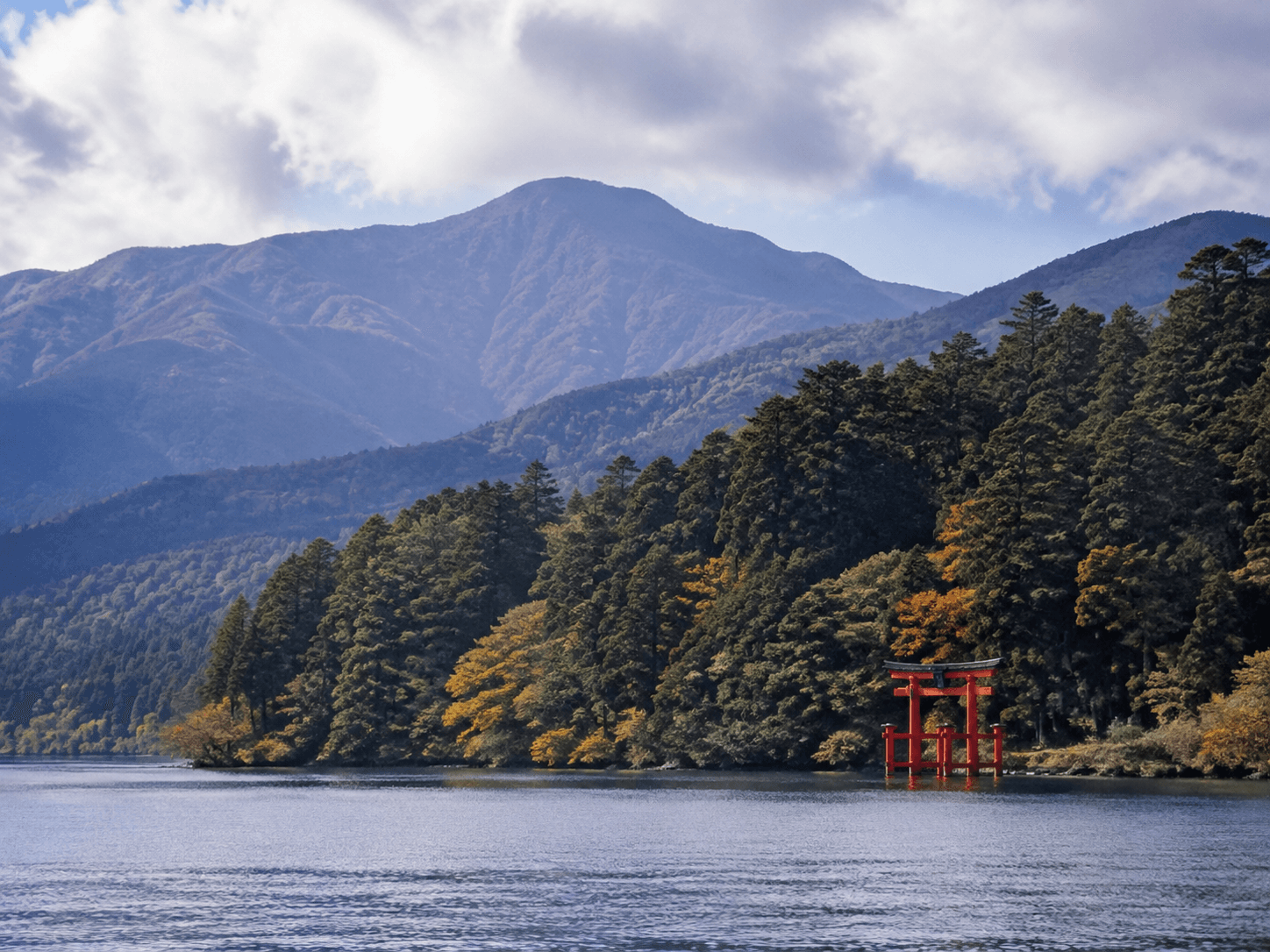
It faces Lake Ashi, with the Torii of Peace standing in the water. Most worshippers pair it with a visit to Kuzuryu Jinja.
Kotokuin(Kamakura)Buddhist temple / National Treasure / Kamakura and Shonan / Blessings: warding off misfortune
A seated Amida Nyorai, a National Treasure. It once sat inside a great hall, but tsunami and typhoons took the building, and it has stood in the open ever since.
Kenchoji(Kamakura)Buddhist temple / First of the Five Great Zen Temples of Kamakura / Important Cultural Property / Kamakura and Shonan / Blessings: warding off misfortune
Held to be the first full Zen temple in Japan, and first of the five great Zen temples of Kamakura.
Kawasaki Daishi(Kawasaki)Buddhist temple / Yokohama and Kawasaki / Blessings: warding off misfortune, road safety
Among the most visited temples in Japan at new year. Known as a Daishi who wards off misfortune, and for the rhythmic sound of sweet-cutting along its approach.
Enoshima Jinja(Fujisawa)Shinto shrine / Important Cultural Property / Kamakura and Shonan / Blessings: the performing arts, love and relationships, wealth
Three shrines in one: Hetsunomiya, Nakatsunomiya and Okutsunomiya. Counted among the three great Benten shrines of Japan, and revered as a deity of the performing arts.
Engakuji(Kamakura)Buddhist temple / Second of the Five Great Zen Temples of Kamakura / National Treasure / Kamakura and Shonan / Blessings: warding off misfortune
Its Shariden is a National Treasure and the leading example of Zen-style architecture. The bell is a National Treasure too.
Hasedera(Kamakura)Buddhist temple / Kamakura and Shonan / Blessings: warding off misfortune, love and relationships
It enshrines an eleven-headed Kannon among the largest wooden figures in Japan. Known for its hydrangeas.
Wakamiya Oji(Kamakura)Shinto shrine / Historic Site / Kamakura and Shonan / Blessings: victory
It runs dead straight from Tsurugaoka Hachimangu to the sea. Yoritomo had it built praying for his wife to give birth safely.
Kenchoji Sanmon(Kamakura)Buddhist temple / Important Cultural Property / Kamakura and Shonan / Blessings: warding off misfortune
Called the tanuki gate, from a legend that a tanuki took the form of the abbot to raise the funds.
Engakuji Shariden(Kamakura)Buddhist temple / National Treasure / Kamakura and Shonan / Blessings: warding off misfortune
A National Treasure, and the leading example of Zen-style architecture.
Meigetsuin(Kamakura)Buddhist temple / Kamakura and Shonan / Blessings: warding off misfortune
The hydrangea temple, known for the garden framed by its round window.
Hokokuji(Kamakura)Buddhist temple / Kamakura and Shonan / Blessings: warding off misfortune
A grove of about 2,000 moso bamboo. It is called the bamboo temple.
Zeniarai Benzaiten(Kamakura)Shinto shrine / Kamakura and Shonan / Blessings: wealth
Coins washed in the spring inside the cave are said to multiply. The custom is traced to a dream that came to Yoritomo.
Sasuke Inari Jinja(Kamakura)Shinto shrine / Kamakura and Shonan / Blessings: good fortune, business prosperity
Vermilion torii line the mountain path. Its deity is said to have urged Yoritomo to raise his army.
Sugimotodera(Kamakura)Buddhist temple / Bando 33 Kannon Pilgrimage, Temple No. 1 / Kamakura and Shonan / Blessings: warding off misfortune
Held to be the oldest temple in Kamakura, with a striking moss-covered stairway.
Tokeiji(Kamakura)Buddhist temple / Kamakura and Shonan / Blessings: love and relationships, rebirth and renewal
It was once an enkiridera, where a woman could obtain a divorce. That refuge worked for six hundred years.
Hasedera Kannon(Kamakura)Buddhist temple / Kamakura and Shonan / Blessings: warding off misfortune
Over nine metres tall, among the largest wooden Kannon figures in Japan.
Daibutsu Tainai(Kamakura)Buddhist temple / National Treasure / Kamakura and Shonan / Blessings: warding off misfortune
You can go inside. The seams of the casting show the technique of the time.
Enoshima Iwaya(Fujisawa)Utaki (Ryukyuan sacred grove) / Kamakura and Shonan / Blessings: the performing arts
Caves cut by the waves. Kukai and Nichiren are said to have practised here, and it is held to be the origin of Enoshima Jinja.
Ryukoji(Fujisawa)Buddhist temple / Kamakura and Shonan / Blessings: warding off misfortune
Where Nichiren was nearly executed, in the incident known as the Tatsunokuchi persecution.
Kuzuryu Jinja(Hakone)Shinto shrine / Western area / Blessings: love and relationships, wealth
It enshrines a dragon in the waters of Lake Ashi. Worshippers gather for the monthly rite on the thirteenth.
Hotoku Ninomiya Jinja(Odawara)Shinto shrine / Western area / Blessings: study and exams, good harvests
It enshrines Ninomiya Sontoku, standing in a corner of the Odawara Castle grounds.
Oyama Afuri Jinja(Isehara)Shinto shrine / Central area / Blessings: mountain worship, warding off misfortune
Hundreds of thousands climbed here each year on the Oyama pilgrimage of the Edo period. As its other name, the rain-falling mountain, suggests, it was a place to pray for rain.
Oyamadera(Isehara)Buddhist temple / Important Cultural Property / Central area / Blessings: warding off misfortune
Halfway up to Afuri Jinja. Known for kawarake-nage, throwing clay discs.
Iseyama Kotai Jingu(Yokohama)Shinto shrine / Yokohama and Kawasaki / Blessings: good fortune
The Ise of eastern Japan. It was built as the tutelary shrine of the newly opened port of Yokohama.
Sojiji(Yokohama)Buddhist temple / major head temple of the Soto Zen school / Yokohama and Kawasaki / Blessings: warding off misfortune
A great head temple of Soto Zen, moved here from Noto. Its precinct is vast.
Amekiri(Kawasaki)Buddhist temple / Yokohama and Kawasaki / Blessings: warding off misfortune
The rhythmic sound of the knives has become the signature of the approach.
Kamakura Daibutsu(Kamakura)Buddhist temple / National Treasure / Kamakura and Shonan / Blessings: warding off misfortune
The great hall was swept away by a tsunami, and the Buddha has sat in the open ever since.
Sanshokan(Yokohama)Buddhist temple / Yokohama and Kawasaki / Blessings: warding off misfortune
The main gate of a great Soto Zen head temple, with the vast precinct of a temple moved from Noto.
Kanteibyo(Yokohama)Buddhist temple / Yokohama and Kawasaki / Blessings: business prosperity
The guardian of Chinatown. It enshrines Guan Yu.
Shomyoji(Yokohama)Buddhist temple / Historic Site / Yokohama and Kawasaki / Blessings: study and exams
It housed the Kanazawa Bunko library. Its Pure Land garden has been restored.
Jufukuji(Kamakura)Buddhist temple / Historic Site / Kamakura and Shonan / Blessings: warding off misfortune
Third of the five great Zen temples of Kamakura. Cave tombs here are said to hold Hojo Masako and Minamoto no Sanetomo.
Jochiji(Kamakura)Buddhist temple / Historic Site / Kamakura and Shonan / Blessings: long life
Fourth of the five great Zen temples of Kamakura. Its Hotei is one of the seven gods of fortune of Kamakura.
Sightseeing
Breakdown: castle 2, historic townscape 2, hot spring 2, nature / scenery 3. 14 places to see in Kanagawa.
Hakone Sekisho(Hakone)castle / Western area / Historic Site / 1619
The hardest stretch of the Tokaido. The stone paving and the cedar avenue survive.
Lake Ashi(Hakone)nature / scenery / Western area
A caldera lake. An inverted Fuji and the Torii of Peace reflect on its surface.
Owakudani(Hakone)hot spring / Western area
The scar of a steam explosion 3,000 years ago. The black eggs are boiled in the hot spring.
Yokohama Red Brick(Yokohama)industrial heritage / Yokohama and Kawasaki / 1911
Bonded warehouses turned into a commercial complex.
Sankeien(Yokohama)garden / park / Yokohama and Kawasaki / Place of Scenic Beauty / Important Cultural Property / 1906
The silk merchant Hara Sankei moved seventeen old buildings here from Kyoto and Kamakura.
Enoshima(Fujisawa)nature / scenery / Kamakura and Shonan
An island joined to the shore by a sandbar. Sea caves and a lookout lighthouse.
Yokohama Chinatown(Yokohama)historic townscape / Yokohama and Kawasaki
The largest Chinatown in Japan, with more than 500 shops.
Odawara-jo(Odawara)castle / Western area / Historic Site / 15th century
The main castle of the Hojo. The outer earthworks that withstood the siege by Hideyoshi survive.
Hakone Old Road(Hakone)industrial heritage / Western area / Historic Site / 1680
Mud roads paved with stone. They survive along with the cedar avenue.
Komachi-dori(Kamakura)historic townscape / Kamakura and Shonan
Beside the approach to Tsurugaoka Hachimangu. A street of souvenirs and street food.
Jogashima(Miura)nature / scenery / Kamakura and Shonan
The Uma-no-se sea arch and the sea cliffs. A peninsula of Miura daikon and tuna.
Yugawara Onsen(Yugawara)hot spring / Western area
An old spring sung of in the Manyoshu. Natsume Soseki and Kunikida Doppo stayed here.
Hiratsuka Tanabata(Hiratsuka)festival / event / Kamakura and Shonan / 1951
It began as a prayer for postwar recovery. Large decorations cover the shopping street.
Keihin Industrial Zone(Kawasaki)industrial heritage / Yokohama and Kawasaki
The lights of the petrochemical plants. Cruises run to see the factory night view.
Traditional Crafts
Three crafts hold national designation: Kamakura-bori carving, Odawara lacquerware and Hakone marquetry.
Hakone marquetry uses no dye at all. The geometric patterns are built only from the natural colours of different woods. The pattern is not drawn on: it is a cross-section.
More: VILLAGE Journal vol.35 — Fitting wood together into pattern(リンク先は現在公開されていません)
More from This Prefecture
See all Kanagawa articles ← All 47 prefectures
Sources: Kanagawa Prefecture, City of Miura, Hakone Town, City of Kamakura, City of Odawara, Tsurugaoka Hachimangu, Agency for Cultural Affairs, Association for the Promotion of Traditional Craft Industries — Value Village editorial team