Tokyo: Local Specialties, Souvenirs, Shrines & Temples, Sightseeing | Japan 47 Prefecture Guide
Tokyo may not come to mind as a place of local specialities. In fact it holds 18 nationally designated traditional crafts, more than any other prefecture in Japan.
Local Specialties
Edo-Tokyo vegetables is the collective name for the heirloom varieties grown here from Edo into the modern city: komatsuna, Nerima daikon, Mikawashima greens, Magome half-white cucumber.
Most of them, though, stopped being grown as the city built over the fields, and were brought back only in recent years. Something is lost, then put back afterwards. It is a shape this series keeps running into.
Out on the islands: ashitaba from Hachijojima, kusaya from the Izu chain. Tokyo as an administrative unit stretches about 1,700 kilometres north to south.
Souvenirs
Kaminari-okoshi is steamed rice dried, fried and bound with sugar syrup. It keeps, and it is light. A finished form for a souvenir sold to pilgrims.
Ningyoyaki, hiyoko, and a glass of Edo kiriko. If you want a craft as a souvenir, this is the way in.
Sacred Sites | Shrines & Temples
Jindaiji and Musashi Mitake Jinja holds National Treasures. 31 shrines and temples worth knowing in Tokyo.
Meiji Jingu(Shibuya)Shinto shrine / Central Tokyo / Blessings: good fortune, love and relationships
That forest was not already there. About 100,000 trees, donated from every part of Japan, were planted by volunteer youth groups: an artificial wood. The species were chosen on the assumption that it would become a natural forest centuries later. A design premised on time its designers would never live to see.
Sensoji(Taito)Buddhist temple / Joto / Blessings: good fortune, warding off misfortune
Held to be the oldest temple in Tokyo. Shops have lined Nakamise, from Kaminarimon to Hozomon, since the Edo period.
Kanda Myojin(Chiyoda)Shinto shrine / Central Tokyo / Blessings: business prosperity, victory, love and relationships
The tutelary shrine of Edo. The Kanda festival is one of the three great festivals of Japan.
Zojoji(Minato)Buddhist temple / Important Cultural Property / Central Tokyo / Blessings: warding off misfortune, safe childbirth
The funerary temple of the Tokugawa. The Sangedatsumon gate survives from the early Edo period.
Hie Jinja(Chiyoda)Shinto shrine / Central Tokyo / Blessings: business prosperity, warding off misfortune, safe childbirth
The guardian of Edo Castle. Its deity was invited from Hiyoshi Taisha in Shiga, and like that shrine its messenger is the sacred monkey. The Sanno festival is one of the three great festivals of Edo.
Yushima Tenmangu(Bunkyo)Shinto shrine / Central Tokyo / Blessings: study and exams
The leading shrine of learning in eastern Japan. In exam season it disappears under votive tablets. It is also known for its plum blossom.
Tomioka Hachimangu(Koto)Shinto shrine / Joto / Blessings: victory, business prosperity
The largest Hachiman shrine in Edo. Public sumo tournaments began here, and a monument to the yokozuna stands in its grounds.
Takahata Fudoson(Hino)Buddhist temple / Important Cultural Property / Tama / Blessings: warding off misfortune, road safety
One of the three great Fudo temples of eastern Japan. The Fudo hall and the Niomon gate are Important Cultural Properties. It is also the funerary temple of Hijikata Toshizo of the Shinsengumi.
Meiji Jingu Forest(Shibuya)Shinto shrine / Central Tokyo / Blessings: good fortune
An artificial wood planted with about 100,000 donated trees. The species were chosen on the assumption it would be natural forest a century on.
Kaminarimon(Taito)Buddhist temple / Joto / Blessings: warding off misfortune
Its formal name is Furaijinmon. A dragon is carved into the base of the great lantern.
Asakusa Jinja(Taito)Shinto shrine / Important Cultural Property / Joto / Blessings: good fortune
The shrine of the Sanja festival. It enshrines the three men who found the principal image of Sensoji.
Nezu Jinja(Bunkyo)Shinto shrine / Important Cultural Property / Central Tokyo / Blessings: warding off misfortune, love and relationships
Its buildings are collectively an Important Cultural Property. Known for its thousand torii and its azalea garden.
Yasukuni Jinja(Chiyoda)Shinto shrine / Central Tokyo / Blessings: warding off misfortune
A cherry tree in its grounds serves as the reference tree for Tokyo's blossom declaration.
Gotokuji(Setagaya)Buddhist temple / Jonan / Blessings: good fortune, business prosperity
It carries a tradition of being the origin of the beckoning cat. Countless dedicated cats stand in rows.
Imado Jinja(Taito)Shinto shrine / Joto / Blessings: love and relationships
Another site claiming the origin of the beckoning cat. Known for matchmaking.
Shinagawa Jinja(Shinagawa)Shinto shrine / One of the Ten Shrines of Tokyo / Jonan / Blessings: business prosperity, wealth
A twin-dragon torii, with dragons coiled around the pillars. A Fuji mound stands in the grounds.
Oji Inari Jinja(Kita)Shinto shrine / Johoku / Blessings: business prosperity, fire protection
It claims to preside over all the Inari shrines of eastern Japan, and is known for the fox procession on New Year's Eve.
Akasaka Hikawa Jinja(Minato)Shinto shrine / One of the Ten Shrines of Tokyo / Important Cultural Property / Central Tokyo / Blessings: love and relationships
Its mid-Edo hall escaped the air raids and survives.
Tokyo Daijingu(Chiyoda)Shinto shrine / Central Tokyo / Blessings: love and relationships
The Ise of Tokyo. Held to be the first shrine in Japan to hold a Shinto wedding.
Hanazono Jinja(Shinjuku)Shinto shrine / Central Tokyo / Blessings: business prosperity, the performing arts
The tutelary shrine of Shinjuku, with its Tori no Ichi market and a history of sideshows and theatre in its grounds.
Fukagawa Fudodo(Koto)Buddhist temple / Joto / Blessings: warding off misfortune
The Tokyo branch of Naritasan. Its prayer hall is covered wall to wall in Sanskrit characters.
Ikegami Honmonji(Ota)Buddhist temple / Important Cultural Property / Jonan / Blessings: warding off misfortune
Where Nichiren died. Its five-storey pagoda is held to be the oldest in eastern Japan.
Jindaiji(Chofu)Buddhist temple / National Treasure / Tama / Blessings: love and relationships, warding off misfortune
Its seated Shaka Nyorai is a National Treasure, made in the Hakuho period. The soba sold at its gate is famous.
Takaosan Yakuoin(Hachioji)Buddhist temple / Tama / Blessings: mountain worship, warding off misfortune
A sacred mountain of tengu belief. Its yearly number of climbers is said to be among the highest in the world.
Musashi Mitake Jinja(Ome)Shinto shrine / National Treasure / Tama / Blessings: warding off misfortune, mountain worship
It holds a National Treasure suit of armour. Dogs may be brought to worship, under a belief in the divine dog.
Ubae Homei Jinja(Hachijo)Shinto shrine / Island districts / Blessings: safe voyages, love and relationships
The tutelary shrine of Hachijojima, the faith of the island of kihachijo silk.
Nogi Jinja(Minato)Shinto shrine / Central Tokyo / Blessings: study and exams, victory
It enshrines General Nogi Maresuke and his wife. Their former residence stands next door.
Kaneiji(Taito)Buddhist temple / Important Cultural Property / Joto / Blessings: warding off misfortune
It took the whole hill of Ueno as its precinct. The other funerary temple of the Tokugawa.
Atago Jinja (Tokyo)(Minato)Shinto shrine / Central Tokyo / Blessings: fire protection, victory
The stairway of success runs to 86 steps, from the legend of Magaki Heikuro, who rode a horse up it.
Suitengu (Tokyo)(Chuo)Shinto shrine / Central Tokyo / Blessings: safe childbirth
Known for prayers for safe childbirth on the day of the dog. A branch of Kurume Suitengu.
Toyokawa Inari Tokyo(Minato)Buddhist temple / Central Tokyo / Blessings: business prosperity
Ooka Echizen was a devotee. Many who work in entertainment come here.
Sightseeing
Ogasawara is a UNESCO World Heritage Site. Breakdown: historic townscape 5, nature / scenery 2, festival / event 2. 17 places to see in Tokyo.
Kanda Matsuri(Chiyoda)festival / event / Central Tokyo
One of the three great festivals of Japan. It was a tenka matsuri, allowed to enter the grounds of Edo Castle.
Nakamise(Taito)historic townscape / Joto
One of the oldest shopping streets in Japan, lined with shops since the Edo period.
Ogasawara(Ogasawara)nature / scenery / Island districts / UNESCO World Heritage (Natural) / UNESCO World Heritage
Islands inscribed as World Natural Heritage. They belong to Tokyo, yet lie about 1,000 kilometres from the mainland.
Sanja Matsuri(Taito)festival / event / Joto
Asakusa in May. Three great portable shrines cross the town.
Shinjuku Gyoen(Shinjuku)garden / park / Central Tokyo / 1906
A Japanese garden, a formal garden and a landscape garden share one site. It was once a daimyo residence.
Rikugien(Bunkyo)garden / park / Central Tokyo / Special Place of Scenic Beauty / 1702
A stroll garden that reproduces places celebrated in waka poetry. Made by Yanagisawa Yoshiyasu.
Hamarikyu(Chuo)garden / park / Central Tokyo / Special Place of Scenic Beauty / Special Historic Site / Historic Site / 1654
A tidal pond fed with seawater. The view changes with the tide.
Edo-Tokyo Museum(Sumida)museum / theatre / Joto / 1993
It reproduces Nihonbashi at full size. Note: closed long-term for renovation.
Kabukiza(Chuo)museum / theatre / Central Tokyo / 1889
The home of kabuki. A single-act seat costs only around a thousand yen.
Toyosu Market(Koto)historic townscape / Joto / 2018
The wholesale market moved here from Tsukiji. The tuna auction can be viewed.
Tsukiji Outer Market(Chuo)historic townscape / Central Tokyo
The wholesale market moved away, but the outer shopping street stayed exactly where it was.
Yanesen(Bunkyo)historic townscape / Central Tokyo
Lanes and row houses that escaped the war. The shopping street runs down from Yuyake Dandan.
Tokyo Skytree(Sumida)museum / theatre / Joto / 2012
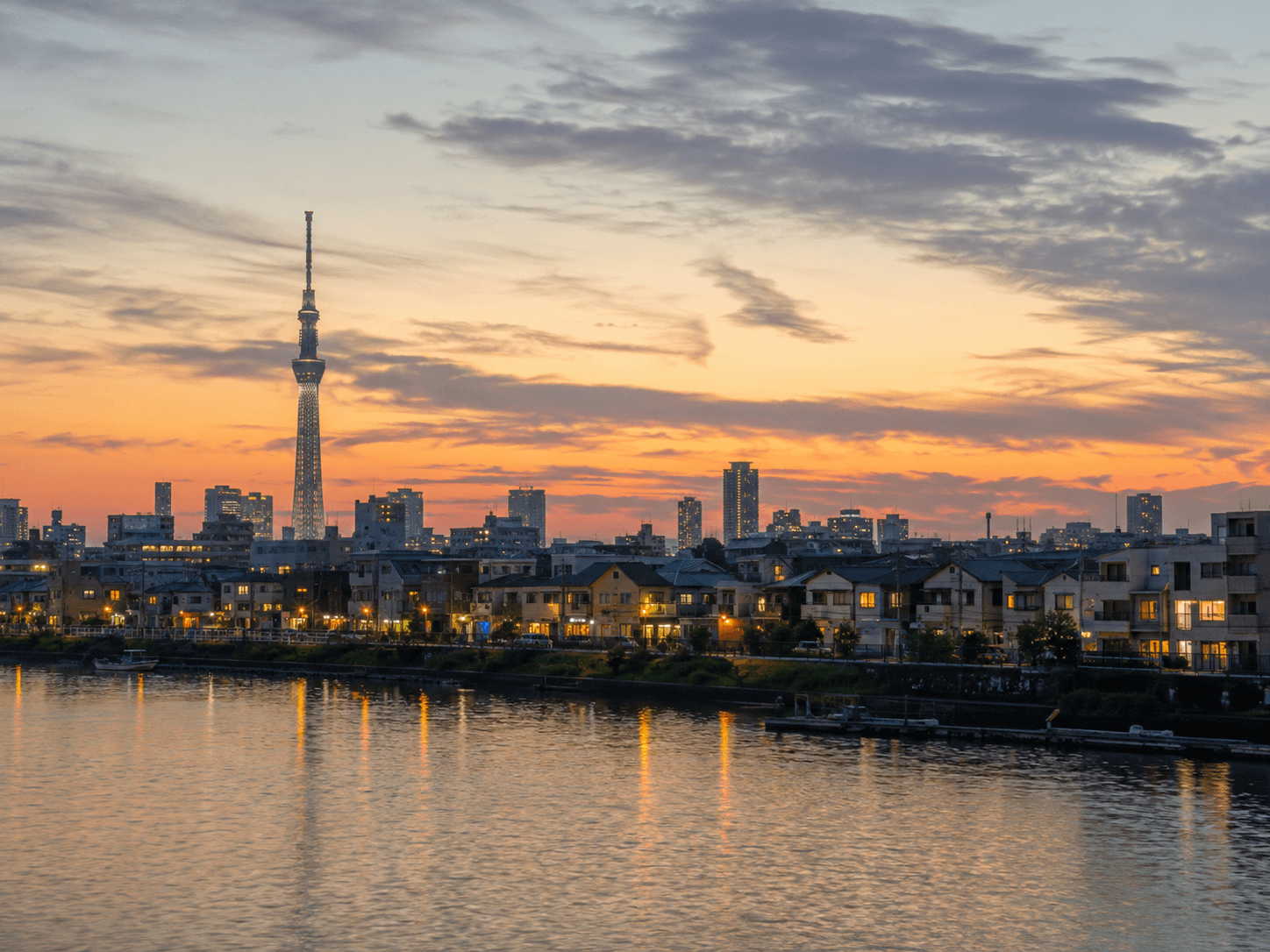
Six hundred and thirty-four metres tall. The idea of the central pillar of a five-storey pagoda was applied to its damping system.
Koishikawa Korakuen(Bunkyo)garden / park / Central Tokyo / Special Historic Site / Special Place of Scenic Beauty / Historic Site / 1629
The garden of the Mito Tokugawa. Much of its design reproduces celebrated places in China.
Mt. Takao(Hachioji)nature / scenery / Tama
An hour from the city centre. Its yearly number of climbers is said to be among the highest in the world.
Inokashira Park(Mitaka)garden / park / Tama / 1917
The source of the Kanda river, and the first suburban park in Japan.
Shibamata(Katsushika)historic townscape / Joto
The setting of the Tora-san films. Kusa-dango shops line the street.
Traditional Crafts
Eighteen crafts, more than any other prefecture. Edo kiriko cut glass, Edo glass, Honba kihachijo silk, Tokyo dyed komon, Edo woodblock prints, Edo joinery, Edo bamboo fishing rods, and more.
What they share is that they were made for townspeople, not for lords. With each sumptuary edict, the work moved further towards effort spent where it cannot be seen from outside.
More: VILLAGE Journal vol.34 — Eighteen crafts, the most in Japan(リンク先は現在公開されていません)
More from This Prefecture
See all Tokyo articles ← All 47 prefectures
Sources: Tokyo Metropolitan Government, Tokyo Federation of Traditional Craft Industries, Taito City, Hachijo Town, Meiji Jingu, Ministry of the Environment, Association for the Promotion of Traditional Craft Industries — Value Village editorial team