Yamanashi: Local Specialties, Souvenirs, Shrines & Temples, Sightseeing | Japan 47 Prefecture Guide
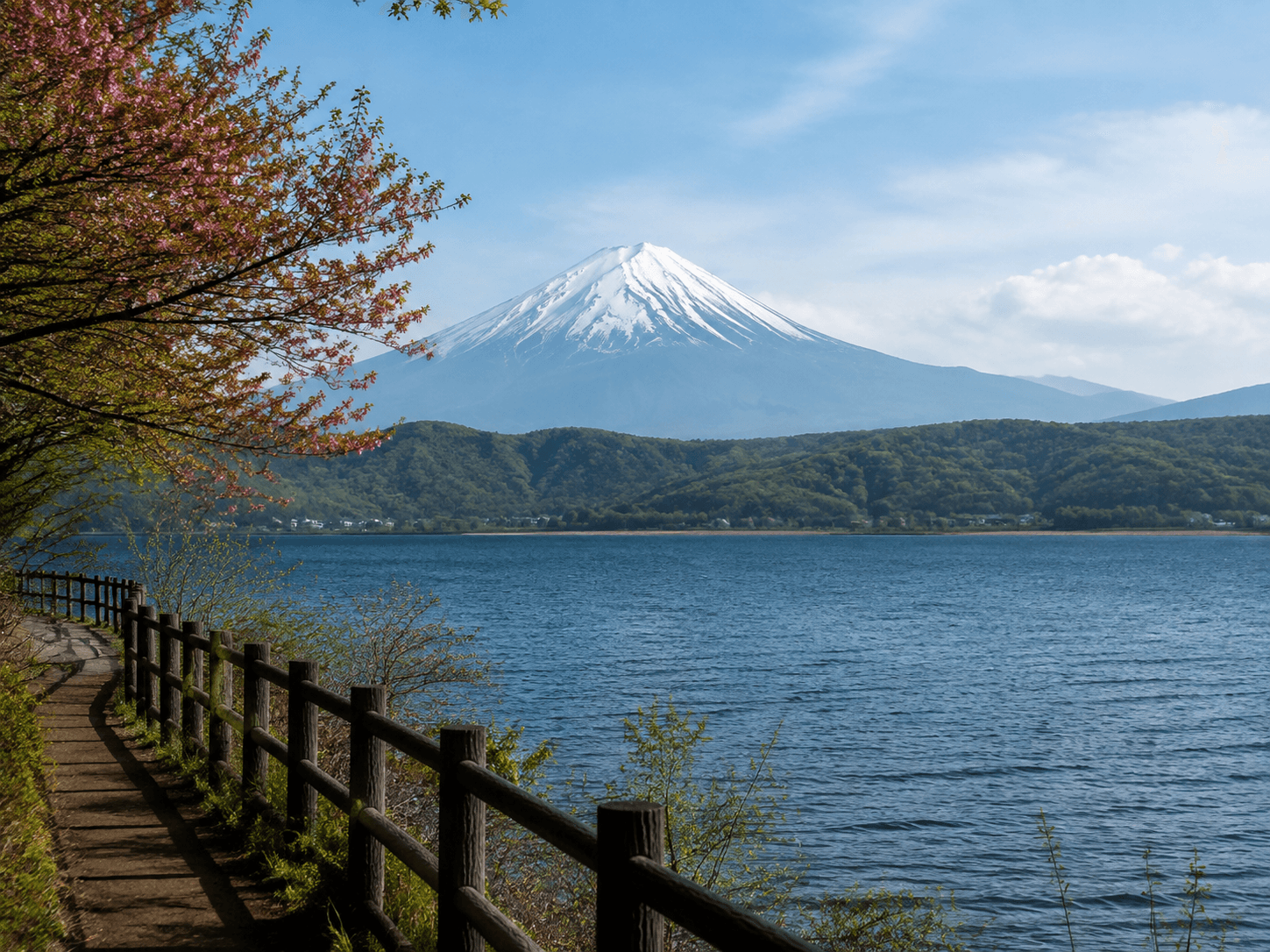
Yamanashi is ringed by mountains on every side, with no coast. That closedness produced both the orchards and the beliefs.
Local Specialties
Yamanashi ranks first in Japan for both grapes and peaches. The Kofu basin has long hours of sunshine, little rain, and a wide gap between day and night temperatures. For fruit trees there is nothing better.
Where there are grapes, there is wine. Winemaking in Japan began in earnest here, in the early Meiji years. The grape variety Koshu is a case of a prefecture's old name becoming the name of a grape known worldwide.
Then rock crystal. Good raw stone was found around the Shosenkyo gorge, and that was the starting point of the jewellery trade.
Souvenirs
Shingen mochi is rice cake dusted with roasted soy flour and eaten with black syrup. It began with the character of a food that keeps and is easy to carry.
Wine, grape confectionery, hoto noodles, and small items in Koshu inden. A wallet of deerskin patterned in lacquer gains its lustre with use.
Sacred Sites | Shrines & Temples
Kitaguchi Hongu Fuji Sengen Jinja and Kawaguchi Asama Jinja and Yoshidaguchi is a UNESCO World Heritage Site. 30 shrines and temples worth knowing in Yamanashi.
Kitaguchi Hongu Fuji Sengen Jinja(Fujiyoshida)Shinto shrine / Important Cultural Property / UNESCO World Heritage (Cultural) / Gunnai (northern foot of Mt. Fuji) / Blessings: mountain worship, warding off misfortune
The start of the Yoshida trail up Mount Fuji. This was the road the Fuji-ko pilgrims of the Edo period took to the summit. A component of the Fujisan World Cultural Heritage site.
Takeda Jinja(Kofu)Shinto shrine / Historic Site / Kuninaka / Blessings: victory
It enshrines Takeda Shingen. Built on the site of the Tsutsujigasaki residence, it recalls that Shingen raised no castle, holding that people were his castle and his stone walls.
Minobusan Kuonji(Minobu)Buddhist temple / head temple of the Nichiren school / Kyonan / Blessings: warding off misfortune, good fortune
The head temple of the Nichiren school. The Bodaitei stairway from the gate to the main hall runs to 287 steps, steep enough to leave you breathless if you climb it in one go.
Kawaguchi Asama Jinja(Fujikawaguchiko)Shinto shrine / UNESCO World Heritage (Cultural) / Gunnai (northern foot of Mt. Fuji) / Blessings: mountain worship, warding off misfortune
Built to quiet the great Jogan eruption. The seven cedars along its approach are a prefectural Natural Monument.
Erinji(Koshu)Buddhist temple / Place of Scenic Beauty / Kuninaka / Blessings: warding off misfortune
The funerary temple of Takeda Shingen. Its garden, laid out by Muso Soseki, is a Place of Scenic Beauty.
Daizenji(Koshu)Buddhist temple / National Treasure / Kuninaka / Blessings: warding off misfortune, good harvests
Its main hall is a National Treasure. Because its principal image holds a bunch of grapes it is called the grape temple, and it carries the tradition of the origin of the Koshu grape.
Yoshidaguchi(Fujiyoshida)Utaki (Ryukyuan sacred grove) / UNESCO World Heritage (Cultural) / Gunnai (northern foot of Mt. Fuji) / Blessings: mountain worship
The path from Kitaguchi Hongu to the summit, walked by the Fuji-ko pilgrims of Edo.
Oshi Jutaku(Fujiyoshida)Utaki (Ryukyuan sacred grove) / Important Cultural Property / UNESCO World Heritage (Cultural) / Gunnai (northern foot of Mt. Fuji) / Blessings: mountain worship
Lodgings that housed Fuji-ko pilgrims. Faith had become a travel business.
Oshino Hakkai(Oshino)Utaki (Ryukyuan sacred grove) / Natural Monument / UNESCO World Heritage (Cultural) / Gunnai (northern foot of Mt. Fuji) / Blessings: rebirth and renewal
Eight pools fed by groundwater from Fuji. They served as the place of purification before the climb.
Kanazakura Jinja(Kofu)Shinto shrine / Kuninaka / Blessings: wealth
Its sacred treasure is rock crystal, and it is held to be the origin of crystal working here. It draws prayers for wealth.
Kai Zenkoji(Kofu)Buddhist temple / Important Cultural Property / Kuninaka / Blessings: rebirth and renewal
Shingen founded it by moving the principal image of Zenkoji in Shinano. Its main hall is among the largest in eastern Japan.
Unpoji(Koshu)Buddhist temple / Important Cultural Property / Kuninaka / Blessings: victory
It preserves the Sun Tzu banner of the Takeda. The main hall and three other buildings are Important Cultural Properties.
Shishinkaku(Minobu)Buddhist temple / Kyonan / Blessings: mountain worship
Where Nichiren thought of his parents back home. A ropeway runs up to it.
Yamanashioka Jinja(Fuefuki)Shinto shrine / Kuninaka / Blessings: warding off misfortune
One theory holds that the prefecture's name, Yamanashi, comes from this shrine.
Asama Jinja (Ichinomiya)(Fuefuki)Shinto shrine / Ichinomiya (first shrine) of Kai Province / Kuninaka / Blessings: mountain worship, safe childbirth
First shrine of Kai Province, built to quiet the eruptions of Fuji.
Inazumi Jinja(Kofu)Shinto shrine / Kuninaka / Blessings: business prosperity
A shrine long revered by the merchants of Kofu.
Kuonji(Minobu)Buddhist temple / head temple of the Nichiren school / Kyonan / Blessings: rebirth and renewal
The head temple of the Nichiren school. You climb the 287 steps of the Bodaitei.
Kakuenpo(Kofu)Utaki (Ryukyuan sacred grove) / Special Place of Scenic Beauty / Kuninaka / Blessings: mountain worship
A rock peak where the monk Kakuen is said to have sat in meditation.
Asama Jinja (Fuefuki)(Fuefuki)Shinto shrine / Kuninaka / Blessings: safe childbirth
First shrine of Kai Province, standing among peach orchards.
Suginamiki(Minobu)Buddhist temple / Kyonan / Blessings: mountain worship
Reachable by ropeway or on foot, with a view of Fuji and Suruga Bay.
Hokoji(Koshu)Buddhist temple / Important Cultural Property / Kuninaka / Blessings: warding off misfortune
Next to Erinji. Known as a temple of flowers.
Ganjoji (Nirasaki)(Nirasaki)Buddhist temple / Important Cultural Property / Kuninaka / Blessings: rebirth and renewal
The funerary temple of Takeda Nobuyoshi, and the birthplace of the Takeda clan.
Shichimenzan(Hayakawa)Buddhist temple / Kyonan / Blessings: mountain worship, rebirth and renewal
At 1,982 metres. It enshrines the guardian deity of women in the Nichiren school, and is famous for the sunrise.
Asama Jinja (Kai Ichinomiya)(Fuefuki)Shinto shrine / Ichinomiya (first shrine) of Kai Province / Kuninaka / Blessings: safe childbirth, mountain worship
Built to quiet the eruptions of Fuji. It stands in the middle of an orchard valley.
Nakiryu(Kofu)Buddhist temple / Kuninaka / Blessings: good fortune
Clap your hands beneath the dragon on the ceiling and the sound comes back.
Oishi Jinja(Fuefuki)Shinto shrine / Kuninaka / Blessings: good harvests
It guards a valley of Koshu grapes and peaches.
Oide Jinja(Tsuru)Shinto shrine / Gunnai (northern foot of Mt. Fuji) / Blessings: warding off misfortune
Floats come out for the Hassaku festival.
Gundari Jinja(Uenohara)Shinto shrine / Gunnai (northern foot of Mt. Fuji) / Blessings: victory, long life
A katsura tree 500 years old stands beside a spring.
Jindai Zakura(Hokuto)Buddhist temple / Natural Monument / Kuninaka / Blessings: long life
Said to be 2,000 years old, one of the three great cherry trees of Japan. Yamato Takeru is said to have planted it.
Honnonji(Minobu)Buddhist temple / Important Cultural Property / Kyonan / Blessings: rebirth and renewal
Founded by Lady Oman, a consort of Tokugawa Ieyasu.
Sightseeing
Fuji Five Lakes and Oshino Hakkai and Lake Yamanaka is a UNESCO World Heritage Site. Breakdown: castle 2, hot spring 1, nature / scenery 6, industrial heritage 2. 15 places to see in Yamanashi.
Daibosatsu Toge(Koshu)festival / event / Kuninaka
The pass road that joined Kai to Musashi. As the name suggests, it was also a road of faith.
Koshu Inden(Kofu)other / Kuninaka
Lacquer patterns laid onto deerskin. A technique from armour, turned to accessories.
Bodaitei(Minobu)festival / event / Kyonan
Two hundred and eighty-seven stone steps, built to mean that climbing them brings you to nirvana.
Tsutsujigasaki(Kofu)castle / Kuninaka / Historic Site / 1519
Shingen raised no castle, holding that people were his castle and his stone walls. The site of his residence is now Takeda Jinja.
Fuji Five Lakes(Fujikawaguchiko and nearby)nature / scenery / Gunnai (northern foot of Mt. Fuji) / UNESCO World Heritage (Cultural) / UNESCO World Heritage
Fuji seen from Lake Motosu is the design on the thousand-yen note. The lakes formed when eruptions dammed the valleys.
Oshino Hakkai(Oshino)nature / scenery / Gunnai (northern foot of Mt. Fuji) / Natural Monument / UNESCO World Heritage (Cultural) / UNESCO World Heritage
Eight pools fed by groundwater from Fuji, used for purification by the Fuji-ko.
Shosenkyo(Kofu)nature / scenery / Kuninaka / Special Place of Scenic Beauty
A granite gorge, with Kakuenpo and Senga Falls. It was also crystal country.
Katsunuma(Koshu)industrial heritage / Kuninaka / 1877
One of the birthplaces of Japanese wine, made from Koshu grapes.
Nishizawa Valley(Yamanashi)nature / scenery / Kuninaka
The five-tiered Nanatsugama falls. Potholes cut into granite by water run one after another.
Maizuru Park(Kofu)castle / Kuninaka / Historic Site / 1590
Stone walls and the Inari turret survive, right in front of Kofu station.
Shingen-ko Festival(Kofu)festival / event / Kuninaka / 1970
A procession of 1,500 warriors, recognised by Guinness.
Lake Yamanaka(Yamanakako)nature / scenery / Gunnai (northern foot of Mt. Fuji) / UNESCO World Heritage (Cultural) / UNESCO World Heritage
The largest of the Fuji Five Lakes, where Diamond Fuji can be seen.
Kiyosato(Hokuto)nature / scenery / Kuninaka
A highland said to have the longest hours of sunshine in Japan.
Koshu Inden(Kofu)industrial heritage / Kuninaka
Lacquer patterns laid onto deerskin. A technique from armour, turned to accessories.
Isawa Onsen(Fuefuki)hot spring / Kuninaka / 1961
It sprang up suddenly out of a vineyard, and was called the open-air spring.
Traditional Crafts
Three crafts hold national designation: Koshu inden, Koshu crystal and gemstone carving, and Koshu hand-carved seals.
All three are work that joins something hard to something soft. Leather and lacquer; stone and blade. And all three are small. That may not be unrelated to being ringed by mountains, where nothing large travelled easily.
More: VILLAGE Journal vol.29 — Laying lacquer onto deerskin(リンク先は現在公開されていません)
More from This Prefecture
See all Yamanashi articles ← All 47 prefectures
Sources: Ministry of Agriculture, Forestry and Fisheries (Crop Statistics Survey), Yamanashi Prefecture, Agency for Cultural Affairs, City of Fujiyoshida, Minobu Town, Association for the Promotion of Traditional Craft Industries — Value Village editorial team