Kagoshima: Local Specialties, Souvenirs, Shrines & Temples, Sightseeing | Japan 47 Prefecture Guide
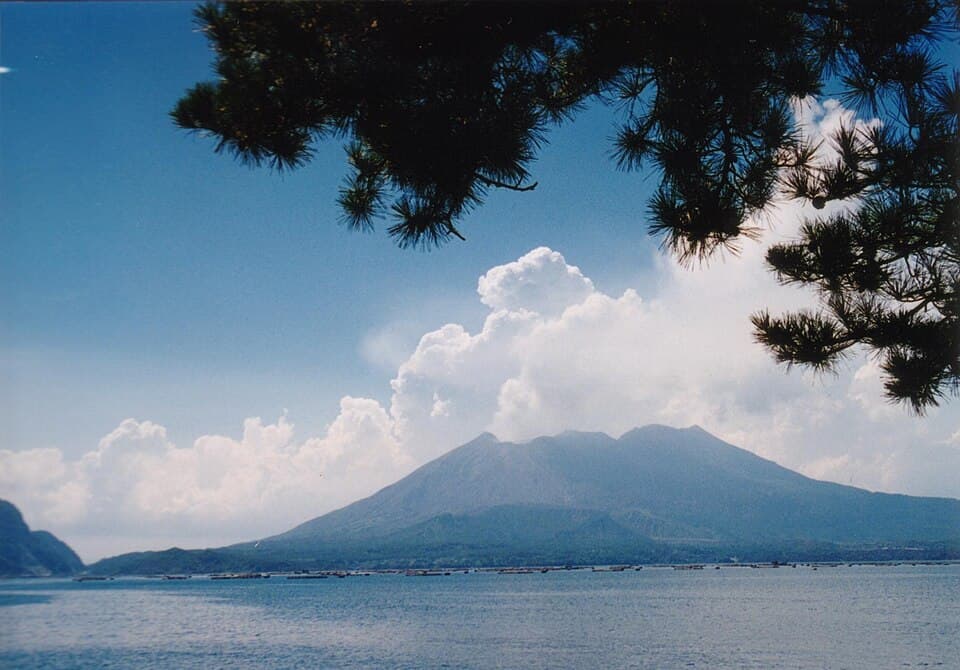
Much of Kagoshima's soil is shirasu plateau, laid down by volcanic eruption. It drains too freely for rice. That constraint made the food of this prefecture.
Local Specialties
Sweet potatoes rank first in Japan for harvest, and so do pigs, including Berkshire pork.
The two are joined. On ground that would not take rice they grew sweet potatoes, fed the trimmings to pigs, and brewed shochu from the crop with barley. Staple, meat and drink all out of one plant. Kagoshima has more authentic shochu distilleries than any other prefecture. A disadvantage became a whole system.
Black wagyu (first in Japan for head raised), yellowtail, local confectionery, dried bonito (Makurazaki is a main producer), and satsuma-age fish cake.
Souvenirs
The kurojoka flask of Satsuma ware, karukan, keihan chicken rice. And Honba Oshima pongee.
Oshima pongee is known for dorozome, dyeing in the mud of Amami Oshima. Thread dyed with an infusion of teechi wood is worked into iron-rich paddy mud dozens of times. A black that can only come from a chemical reaction.
Sacred Sites | Shrines & Temples
Amami is a UNESCO World Heritage Site. 28 shrines and temples worth knowing in Kagoshima.
Kirishima Jingu(Kirishima)Shinto shrine / National Treasure / Kirishima / Blessings: good fortune, love and relationships, mountain worship
A shrine tied to the legend of the descent of the heavenly grandson, its main hall a National Treasure. Eruptions of Mount Kirishima burned it down again and again, and each time it was rebuilt somewhere else. The present halls date from 1715, given by the Shimazu. Places of worship in southern Kyushu are built on the assumption of living with a volcano.
Kagoshima Jingu(Kirishima)Shinto shrine / Ichinomiya (first shrine) of Osumi Province / Important Cultural Property / Kirishima / Blessings: safe childbirth, good harvests, long life
It is tied to the myth of Yamasachihiko, held to be the original of the Urashima Taro tale. At the Hatsuuma festival, horses hung with bells dance.
Hirakiki Jinja(Ibusuki)Shinto shrine / Ichinomiya (first shrine) of Satsuma Province / Important Cultural Property / Nansatsu / Blessings: safe voyages, good fortune
First shrine of Satsuma Province, standing with Mount Kaimon at its back. It has long drawn prayers for safe voyages and safe travel.
Terukuni Jinja(Kagoshima)Shinto shrine / Kagoshima / Blessings: good fortune, victory
The tutelary deity of Kagoshima, enshrining Shimazu Nariakira. A great torii stands at the foot of Shiroyama.
Kirishima Jingu Honden(Kirishima)Shinto shrine / National Treasure / Kirishima / Blessings: good fortune
Vermilion halls in brilliant colour, a National Treasure. It is called the Nikko of the west.
Takachihogawara(Kirishima)Utaki (Ryukyuan sacred grove) / Kirishima / Blessings: mountain worship
The original site of Kirishima Jingu. It burned in an eruption, and only the old shrine ground remains.
Kurokami Torii(Kagoshima)Shinto shrine / Kagoshima / Blessings: rebirth and renewal
In the Taisho eruption a torii three metres high was buried up to its top rail.
Kaimondake(Ibusuki)Utaki (Ryukyuan sacred grove) / Nansatsu / Blessings: mountain worship
The Fuji of Satsuma. A cone rising straight out of the sea.
Yaku Jinja(Yakushima)Shinto shrine / Outer islands / Blessings: mountain worship
The base for the mountain pilgrimages of Yakushima.
Amami(Amami)Shinto shrine / UNESCO World Heritage (Natural) / Outer islands / Blessings: safe voyages
Each village on the island keeps its own sacred ground, called a kamiyama. Amami Oshima is a World Natural Heritage site.
Homan Jinja(Minamitane)Shinto shrine / Outer islands / Blessings: good harvests
It preserves a rite using red rice, keeping an old form of rice growing in Japan.
Kamo Hachimangu(Aira)Shinto shrine / Natural Monument / Kagoshima / Blessings: long life, victory
The great camphor of Kamo in its grounds is the largest tree in Japan, 24 metres round the trunk.
Terukuni Otorii(Kagoshima)Shinto shrine / Kagoshima / Blessings: good fortune
It stands at the centre of the city with Sakurajima behind it.
Arata Hachimangu(Kagoshima)Shinto shrine / Kagoshima / Blessings: victory
One of the tutelary shrines of Satsuma.
Fukushoji(Kagoshima)Buddhist temple / Kagoshima / Blessings: rebirth and renewal
The funerary temple of the Shimazu. It was lost in the anti-Buddhist movement, and only the graves remain.
Shakutai Jinja(Kirishima)Shinto shrine / Kirishima / Blessings: safe childbirth
The original shrine of Kagoshima Jingu. You take a pebble home, and return twice as many after a safe birth.
Kiyomizu Magaibutsu(Minamikyushu)Buddhist temple / Nansatsu / Blessings: warding off misfortune
Hundreds of five-ringed pagodas and Sanskrit characters are carved into the cliff along the Manose river.
Toyotamahime Jinja(Minamikyushu)Shinto shrine / Nansatsu / Blessings: safe childbirth
The shrine of the Chiran Nebuta festival.
Kamafuta Jinja(Minamikyushu)Shinto shrine / Nansatsu / Blessings: victory, warding off misfortune
Worshippers walk the approach with a pot lid balanced on their heads. A faith for fortune in war and in contests.
Chokushiden(Ibusuki)Shinto shrine / Important Cultural Property / Nansatsu / Blessings: safe voyages
A vermilion envoy hall, standing with Mount Kaimon at its back.
Tokumitsu Jinja(Ibusuki)Shinto shrine / Nansatsu / Blessings: good harvests, business prosperity
It enshrines Maeda Riemon, who spread the sweet potato through Japan.
Minamikata Jinja(Makurazaki)Shinto shrine / Nansatsu / Blessings: good catches, safe voyages
The tutelary shrine of a bonito town.
Takachiho Jinja (Amami)(Amami)Shinto shrine / Outer islands / Blessings: good fortune
The tutelary shrine of Amami Oshima.
Yaku Jinja(Yakushima)Shinto shrine / Outer islands / Blessings: mountain worship
The starting point for the mountain pilgrimages of Yakushima.
Homan Jinja(Minamitane)Shinto shrine / Outer islands / Blessings: good harvests
A rite that guards and hands on red rice, keeping an old form of Japanese rice growing.
Kamiyama(Amami)Utaki (Ryukyuan sacred grove) / Outer islands / Blessings: rebirth and renewal
Sacred ground surviving in each village. A form of island faith apart from shrines.
Hakozaki Hachiman Jinja(Izumi)Shinto shrine / Kirishima / Blessings: safe voyages, good fortune
It displays the largest bell in Japan.
Nitta Jinja(Satsumasendai)Shinto shrine / Ichinomiya (first shrine) of Satsuma Province / Kagoshima / Blessings: good fortune
First shrine of Satsuma Province, standing on Mount Shinki.
Sightseeing
Senganen and Shuseikan and Jomon Sugi is a UNESCO World Heritage Site. Breakdown: castle 2, historic townscape 1, hot spring 2, nature / scenery 9. 19 places to see in Kagoshima.
Chiran Buke Yashiki(Minamikyushu)garden / park / Nansatsu / Important Preservation District for Groups of Traditional Buildings / Preservation District for Traditional Buildings
The little Kyoto of Satsuma. Seven of its gardens are Places of Scenic Beauty.
Sunamushi(Ibusuki)historic townscape / Nansatsu
You are buried in the sand of the beach, a way of bathing rare anywhere in the world.
Izumi Fumoto(Izumi)castle / Kirishima / Important Preservation District for Groups of Traditional Buildings / Preservation District for Traditional Buildings
The largest outer fortress town of the Satsuma domain. A town of samurai who guarded the border.
Izumi Tsuru(Izumi)nature / scenery / Kirishima / Special Natural Monument / Natural Monument
One of the largest wintering grounds for cranes in the world. More than ten thousand birds arrive.
Hatsuuma-sai(Kirishima)festival / event / Kirishima / Important Intangible Folk Cultural Property
Horses hung with bells move up the approach as if dancing.
Kirishima Onsen(Kirishima)hot spring / Kirishima
A gift of the volcano. It was where the mountain ascetics took the waters.
Sakurajima(Kagoshima)nature / scenery / Kagoshima
It is still erupting. The 1914 eruption joined it to the Osumi peninsula.
Senganen(Kagoshima)garden / park / Kagoshima / Place of Scenic Beauty / UNESCO World Heritage (Cultural) / UNESCO World Heritage / 1658
A garden that treats Sakurajima as its artificial hill and Kinko Bay as its pond. The remains of the Shuseikan works stand alongside.
Shiroyama(Kagoshima)castle / Kagoshima / Historic Site
The cave where Saigo Takamori met his end survives here.
Shuseikan(Kagoshima)industrial heritage / Kagoshima / Important Cultural Property / UNESCO World Heritage (Cultural) / UNESCO World Heritage / 1865
A World Cultural Heritage component of the Sites of Japan's Meiji Industrial Revolution. Among the oldest Western-style factory buildings in Japan.
Jomon Sugi(Yakushima)nature / scenery / Outer islands / UNESCO World Heritage (Natural) / UNESCO World Heritage
Estimated at between 2,000 and 7,000 years old. It lies at the end of a ten-hour round trip on foot.
Shiratani Unsuikyo(Yakushima)nature / scenery / Outer islands / UNESCO World Heritage (Natural) / UNESCO World Heritage
Primeval forest under a covering of moss. The source of the water of Yakushima.
Yakushima(Yakushima)nature / scenery / Outer islands / UNESCO World Heritage (Natural) / UNESCO World Heritage
They say it rains thirty-five days a month here. A cedar estimated at between 2,000 and 7,000 years old.
Sunamushi(Ibusuki)hot spring / Nansatsu
You are buried in the sand of the beach, a way of bathing rare anywhere in the world.
Amami Oshima(Amami and nearby)nature / scenery / Outer islands / UNESCO World Heritage (Natural) / UNESCO World Heritage
Home of the Amami rabbit. Primeval mangrove forest.
Kirishima(Kirishima and nearby)nature / scenery / Kirishima
One of the first national parks in Japan, and the stage of the myth of the descent of the heavenly grandson.
Satsuma Kiriko(Kagoshima)industrial heritage / Kagoshima / 1851
Thick coloured glass is cut back to produce a graded shading. Production died out once and was revived.
Izumi Cranes(Izumi)nature / scenery / Kirishima / Special Natural Monument / Natural Monument
One of the largest wintering grounds for cranes in the world. More than ten thousand birds arrive.
Mt. Kaimon(Ibusuki)nature / scenery / Nansatsu
The Fuji of Satsuma. A cone rising straight out of the sea.
Traditional Crafts
Three crafts hold national designation: Honba Oshima pongee, Satsuma ware, and Kawanabe Buddhist altars.
Satsuma ware is said to have been begun by potters who came from the Korean peninsula after the Bunroku-Keicho campaigns, the same course as Hagi ware in Yamaguchi and Arita ware in Saga. That it divided into shiromon, the white ware for presentation, and kuromon, the everyday ware of ordinary people, is the same structure as Mikawachi and Hasami in Nagasaki.
More: VILLAGE Journal vol.8 — The white ware and the black(リンク先は現在公開されていません)
More from This Prefecture
See all Kagoshima articles ← All 47 prefectures
Sources: Kagoshima Prefecture, City of Kagoshima, City of Kirishima, City of Ibusuki, City of Amami, National Tax Agency, Ministry of Agriculture, Forestry and Fisheries, Agency for Cultural Affairs, Association for the Promotion of Traditional Craft Industries — Value Village editorial team