Yamagata: Local Specialties, Souvenirs, Shrines & Temples, Sightseeing | Japan 47 Prefecture Guide
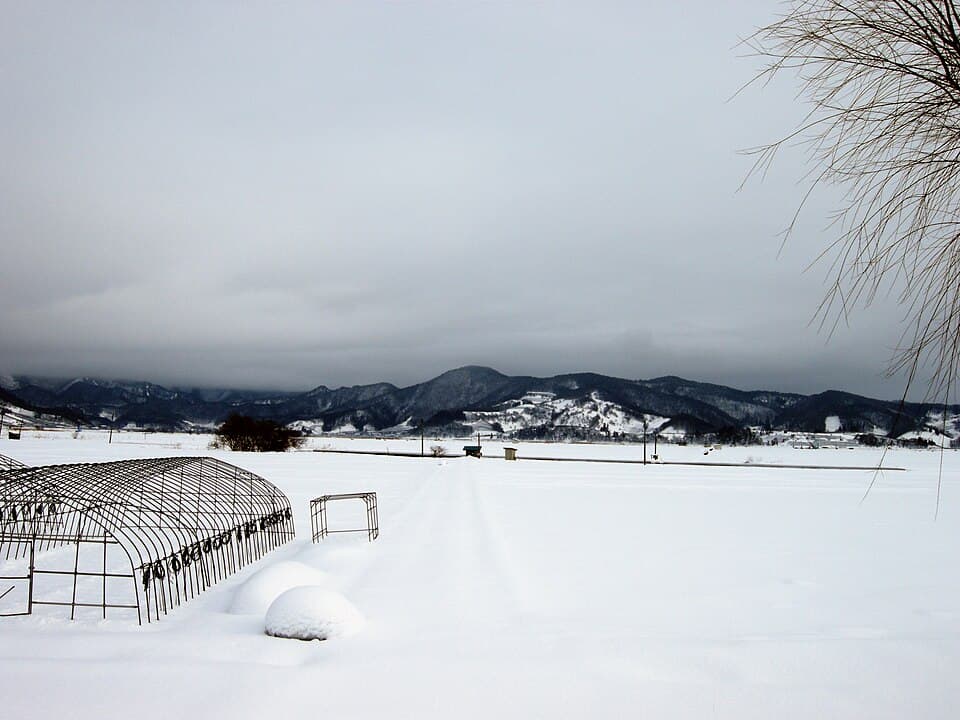
Yamagata is an unusual place: one prefecture holding fruit, rice and beef at the same time. Basin, mountain and river each raise something different.
Local Specialties
Yamagata harvests more cherries than any other prefecture: about 70 percent of the national crop. The leading variety, Sato Nishiki, took Sato Eisuke sixteen years to breed, between the Taisho era and the early Showa years.
European pears, La France, also rank first in Japan. These are a fruit that only comes to eating condition after ripening off the tree.
What suits fruit trees is a basin with a wide gap between day and night temperatures. The Yamagata basin is ringed by mountains: hot in summer, cold at night. The same logic that produced Aomori's apples, working on a different fruit.
Yonezawa beef is counted among the three great wagyu, and the prefecture has its own rice varieties, Tsuyahime among them.
Souvenirs
Cherry sweets and cherry juice. And tama konnyaku, sold on skewers along the approach to Yamadera.
Dashi is aubergine and cucumber chopped fine and seasoned. A home dish for the hot Yamagata summer, spooned over rice, that became a souvenir.
Sacred Sites | Shrines & Temples
Hagurosan Gojunoto holds National Treasures. 30 shrines and temples worth knowing in Yamagata.
Dewa Sanzan Jinja(Tsuruoka)Shinto shrine / Dewa Province / National Treasure (Haguroyama Five-Storey Pagoda) / Shonai / Blessings: rebirth and renewal, mountain worship, long life
Haguro is the present, Gassan the past and death, Yudono the future and rebirth. To walk the three in order has long been called a journey of rebirth: the meaning is in the sequence itself. The stone stairway through the cedars runs to 2,446 steps.
Risshakuji (Yamadera)(Yamagata)Buddhist temple / Important Cultural Property / Historic Site / Place of Scenic Beauty / Murayama / Blessings: warding off misfortune, mountain worship
Halls built onto the rock of the mountain. It is 1,015 steps to the innermost hall. This is where Basho wrote of the cicadas' voices soaking into the rock.
Uesugi Jinja(Yonezawa)Shinto shrine / Okitama / Blessings: victory, study and exams
It enshrines Uesugi Kenshin. Standing on the honmaru of Yonezawa Castle, it has served as the centre of the castle town.
Kumano Taisha(Nanyo)Shinto shrine / One of the Three Kumano Shrines / Important Cultural Property / Okitama / Blessings: love and relationships
Counted with Kii as one of the three Kumano shrines of Japan. Three rabbits are said to be hidden in the carving behind the main hall, and looking for them has become part of the visit.
Jakushoji(Tendo)Buddhist temple / Important Cultural Property / Murayama / Blessings: love and relationships
Known as a Kannon of matchmaking. The temple sung of in the Hanagasa Ondo.
Shonai Jinja(Tsuruoka)Shinto shrine / Shonai / Blessings: good fortune, victory
It stands on the site of Tsurugaoka Castle and enshrines the Sakai, lords of the Shonai domain. The centre of the castle town.
Hagurosan Gojunoto(Tsuruoka)Shinto shrine / National Treasure / Shonai / Blessings: mountain worship, rebirth and renewal
A National Treasure pagoda standing among the cedars, held to be the oldest in northern Japan.
Gassan Jinja(Tsuruoka)Shinto shrine / One of the Three Mountains of Dewa / Shonai / Blessings: rebirth and renewal, mountain worship
At the 1,984-metre summit. Within the three mountains of Dewa it carries the past, and death.
Yudonosan Jinja(Tsuruoka)Shinto shrine / One of the Three Mountains of Dewa / Shonai / Blessings: rebirth and renewal
Do not speak of it, do not listen: so the rule runs. There is no hall; the rock with its scalding spring is itself the deity.
Dainichibo(Tsuruoka)Buddhist temple / Shonai / Blessings: rebirth and renewal, long life
It enshrines a sokushinbutsu, a self-mummified monk: an ascetic of the Yudonosan faith who made a buddha of his own body.
Churenji(Tsuruoka)Buddhist temple / Shonai / Blessings: rebirth and renewal
A temple that enshrines a sokushinbutsu, and the setting of Mori Atsushi's novel Gassan.
Konpon Chudo(Yamagata)Buddhist temple / Important Cultural Property / Murayama / Blessings: warding off misfortune
The undying dharma lamp, divided from Enryakuji, still burns here.
Uesugi Byosho(Yonezawa)Buddhist temple / Historic Site / Okitama / Blessings: victory
The mausolea of Kenshin and the lords who followed him stand in a stand of cedars.
Zao Jizoson(Yamagata)Buddhist temple / Murayama / Blessings: warding off misfortune
A Jizo standing in the field of frost-covered trees. In winter it is buried in snow, with only its face showing.
Zenpoji(Tsuruoka)Buddhist temple / Shonai / Blessings: good catches, safe voyages
It enshrines a dragon deity and draws the faith of fishermen. A five-storey pagoda stands here.
Kenkun Jinja(Tendo)Shinto shrine / Murayama / Blessings: victory
It enshrines Oda Nobunaga. Tied to the Tendo Oda domain, it also lies behind the town's identity as a place of shogi.
Sanjin Gosaiden(Tsuruoka)Shinto shrine / One of the Three Mountains of Dewa / Important Cultural Property / Shonai / Blessings: rebirth and renewal, mountain worship
The deities of all three mountains are enshrined under one roof. The thatched roof is over two metres thick.
Ishidan(Tsuruoka)Shinto shrine / Shonai / Blessings: rebirth and renewal
Two thousand four hundred and forty-six steps. Thirty-three carvings are hidden along the cedar avenue, and finding them is said to grant a wish.
Godaido (Yamadera)(Yamagata)Buddhist temple / Murayama / Blessings: mountain worship
A platform thrust out from the cliff. The finest view at Yamadera.
Hie Jinja (Sakata)(Sakata)Shinto shrine / Shonai / Blessings: business prosperity, safe voyages
The tutelary shrine of a port town made rich by the kitamaebune trade. Floats come out for the Sakata festival.
Shonai Jinja(Tsuruoka)Shinto shrine / Shonai / Blessings: good fortune
It stands on the site of Tsurugaoka Castle and enshrines the Sakai family, lords of Shonai.
Rinsenji (Yonezawa)(Yonezawa)Buddhist temple / Okitama / Blessings: study and exams
A temple long tied to the Uesugi. The grave of Naoe Kanetsugu is here.
Tozawa Jinja(Shinjo)Shinto shrine / Mogami / Blessings: victory
The centre of the Shinjo festival, whose float rite is UNESCO Intangible Cultural Heritage.
Kattamine Okumiya(Kaminoyama)Shinto shrine / Murayama / Blessings: mountain worship
It stands beside the crater lake, and is shut in by snow through the winter.
Jakushoji(Tendo)Buddhist temple / Important Cultural Property / Murayama / Blessings: love and relationships
The first temple of the Mogami 33 Kannon pilgrimage, known as a Kannon of matchmaking.
Niomon (Yamadera)(Yamagata)Buddhist temple / Murayama / Blessings: warding off misfortune
A gate of zelkova. Beyond it the path runs to the innermost hall.
Tsukioka Jinja(Kaminoyama)Shinto shrine / Murayama / Blessings: good fortune
It stands on the site of Kaminoyama Castle, and is known for its scarecrow festival.
Somiya Jinja(Nagai)Shinto shrine / Okitama / Blessings: good harvests
Said to have been founded by Sakanoue no Tamuramaro. Great cedars line the approach.
Jionji(Sagae)Buddhist temple / Historic Site / Murayama / Blessings: warding off misfortune
A temple that was once among the largest in northern Japan. A nationally designated Historic Site.
Ayukai Hachimangu(Shirataka)Shinto shrine / Okitama / Blessings: victory
An old shrine of the Mogami river basin.
Sightseeing
Breakdown: castle 2, historic townscape 2, hot spring 2, nature / scenery 5. 15 places to see in Yamagata.
Mogamigawa(Oishida)other / Murayama
Small shrines praying for safe passage are dotted along the river.
Sakata Hiyoriyama(Sakata)nature / scenery / Shonai
The hill where kitamaebune waited for a wind. A place for reading direction became a place of worship as well.
Shonai Han(Tsuruoka)castle / Shonai
The heart of the Tsurugaoka Castle site. The frame of the castle town is still visible.
Yamadera Okunoin(Yamagata)nature / scenery / Murayama
The hall at the top of 1,015 steps. The valley of Tachiyazawa opens out below.
Ginzan Onsen(Obanazawa)hot spring / Murayama
Wooden inns from the Taisho era line both banks of the river. Gas lamps are lit at night.
Hanagasa Matsuri(Yamagata)festival / event / Murayama
Dancers spin hats decorated with safflower.
Zao Snow Monsters(Yamagata)nature / scenery / Murayama
The snow monsters. One of the few large fields of frost-covered trees anywhere in the world.
Mogami River Cruise(Tozawa)nature / scenery / Mogami
The river Basho described as gathering the summer rains and running fast. The boatmen sing.
Yamadera(Yamagata)historic townscape / Murayama
Chikara konnyaku and tama konnyaku. Custom says you eat before you climb.
Zao Onsen(Yamagata)hot spring / Murayama
A strongly acidic sulphur spring, said to have been opened 1,900 years ago.
Yonezawa Beef(Yonezawa)historic townscape / Okitama
One of the three great wagyu of Japan. An English teacher is credited with making it known.
Tobishima(Sakata)nature / scenery / Shonai
The only inhabited island in Yamagata, and a staging post for migrating birds.
Kaminoyama-jo(Kaminoyama)castle / Murayama / 1535
Called one of the fine castles of Dewa. The castle town is known for its scarecrow festival.
Sanno Club(Sakata)museum / theatre / Shonai / 1895
A restaurant of the kitamaebune era. It displays kasafuku hanging ornaments.
Tendo Shogi Piece(Tendo)industrial heritage / Murayama
Most of the shogi pieces made in Japan come from here. The stage of human shogi.
Traditional Crafts
Nationally designated: Tendo shogi pieces, Yamagata cast metalwork, Yamagata Buddhist altars, Okitama pongee, and Uetsu shina cloth.
Tendo makes most of the shogi pieces produced in Japan. It began when a small domain encouraged the work as a sideline for its lower-ranking samurai.
More: VILLAGE Journal vol.43 — Nine in ten shogi pieces(リンク先は現在公開されていません)
More from This Prefecture
See all Yamagata articles ← All 47 prefectures
Sources: Ministry of Agriculture, Forestry and Fisheries (Crop Statistics Survey), Yamagata Prefecture, City of Tendo, City of Tsuruoka, Dewa Sanzan Jinja, Association for the Promotion of Traditional Craft Industries — Value Village editorial team