Yamaguchi: Local Specialties, Souvenirs, Shrines & Temples, Sightseeing | Japan 47 Prefecture Guide
Yamaguchi is the western end of Honshu. Sea on three sides, and Kyushu facing it across the Kanmon Strait.
Local Specialties
Pufferfish: the Haedomari market in Shimonoseki is known across Japan as the trading centre for it. Locally it is called fuku, punning on the word for good fortune.
Pufferfish is poisonous, so preparing it requires a prefectural licence. Exactly where the knife may go, and exactly which parts must be thrown away, are laid down in detail. Saying that pufferfish is the local speciality really means that the people who hold that skill are gathered here.
Natsumikan, which originated at Senzaki in Nagato; Mishima beef; Iwakuni lotus root; and Yamaguchi sake. Brewers who have led the export of Japanese sake are in this prefecture.
Souvenirs
Overnight-dried pufferfish, natsumikan confectionery, uiro manju. And a Hagi ware tea bowl.
Uiro manju is a steamed bun from Iwakuni: smooth bean paste wrapped in a glutinous rice dough, somewhere between a mochi and a manju.
Sacred Sites | Shrines & Temples
Shoin Jinja is a UNESCO World Heritage Site. 29 shrines and temples worth knowing in Yamaguchi.
Motonosumi Jinja(Nagato)Shinto shrine / Western area / Blessings: business prosperity, good fortune
One hundred and twenty-three torii run about 100 metres out towards the sea. A comparatively new shrine, built after a white fox appeared in the dream of a local fisherman. The torii went on being dedicated over more than a decade. The same structure as the thousand torii at Fushimi Inari or the lanterns at Kasuga Taisha, still working in postwar Japan.
Hofu Tenmangu(Hofu)Shinto shrine / One of the Three Great Tenjin Shrines / Central area / Blessings: study and exams
Held to be the earliest founded of the Tenmangu shrines to Sugawara no Michizane, and counted with Kitano and Dazaifu among the three great Tenjin shrines of Japan.
Akama Jingu(Shimonoseki)Shinto shrine / Western area / Blessings: warding off misfortune, safe voyages
It enshrines Emperor Antoku, who drowned at Dannoura. Known for its red and white Suitenmon gate, which recalls the palace of the dragon king.
Rurikoji(Yamaguchi)Buddhist temple / National Treasure / Central area / Blessings: warding off misfortune
Its five-storey pagoda is a National Treasure, counted with Daigoji and Hokanji among the three finest pagodas of Japan.
Sumiyoshi Jinja(Shimonoseki)Shinto shrine / Ichinomiya (first shrine) of Nagato Province / One of the Three Great Sumiyoshi Shrines / National Treasure / Western area / Blessings: safe voyages, victory
Its main hall is a National Treasure. With Osaka and Hakata it is counted among the three great Sumiyoshi shrines. Its kukensha nagare-zukuri form is unusual.
Shoin Jinja(Hagi)Shinto shrine / Historic Site / UNESCO World Heritage (Cultural) / Kitaura (Hagi) / Blessings: study and exams
It enshrines Yoshida Shoin. The Shoka Sonjuku school in its grounds is a component of the World Cultural Heritage Sites of Japan's Meiji Industrial Revolution.
Rurikoji Gojunoto(Yamaguchi)Buddhist temple / National Treasure / Central area / Blessings: warding off misfortune
One of the three finest pagodas of Japan, and held to be the summit of Ouchi culture.
Tokoji(Hagi)Buddhist temple / Important Cultural Property / Kitaura (Hagi) / Blessings: rebirth and renewal
The funerary temple of the Mori family. Over 500 stone lanterns stand in rows around the graves.
Daishoin(Hagi)Buddhist temple / Important Cultural Property / Kitaura (Hagi) / Blessings: rebirth and renewal
The other Mori funerary temple, paired with Tokoji. The even-numbered lords lie here.
Kameyama Hachimangu(Shimonoseki)Shinto shrine / Western area / Blessings: safe voyages, business prosperity
It looks down on the Kanmon Strait. A monument here records the origin of eating pufferfish.
Shirohebi Jinja(Iwakuni)Shinto shrine / Natural Monument / Eastern area / Blessings: wealth
The white snakes of Iwakuni are a Natural Monument, held to be messengers of Benzaiten.
Kikko Jinja(Iwakuni)Shinto shrine / Important Cultural Property / Eastern area / Blessings: victory
It enshrines the Kikkawa, lords of the Iwakuni domain, at the foot of Kintaikyo.
Xavier Memorial Church(Yamaguchi)church / Central area / Blessings: rebirth and renewal
Where Xavier was first permitted to preach in Japan. One of the starting points of Japanese Christian history.
Sesshutei(Yamaguchi)Buddhist temple / Historic Site / Place of Scenic Beauty / Central area / Blessings: study and exams
A garden attributed to Sesshu.
Hanaoka Hachimangu(Kudamatsu)Shinto shrine / Important Cultural Property / Eastern area / Blessings: victory
Its tahoto pagoda is an Important Cultural Property, a trace of the old fusion of Shinto and Buddhism.
Yamaguchi Daijingu(Yamaguchi)Shinto shrine / Central area / Blessings: good fortune
Held to be the first shrine to receive a division of the deity of Ise Jingu, and called the Ise of the west.
Toshunji(Yamaguchi)Buddhist temple / Important Cultural Property / Central area / Blessings: victory
The funerary temple of Mori Motonari. Its gate and Kannon hall are Important Cultural Properties.
Amidaji (Hofu)(Hofu)Buddhist temple / Important Cultural Property / Central area / Blessings: long life
Founded by Chogen, who rebuilt Todaiji. Known as a temple of hydrangeas.
Heikezuka(Shimonoseki)Shinto shrine / Western area / Blessings: rebirth and renewal
The setting of Hoichi the Earless. The mounds of the Taira clan stand in rows.
Kozanji(Shimonoseki)Buddhist temple / National Treasure / Western area / Blessings: victory
Its Buddha hall is a National Treasure. Where Takasugi Shinsaku raised his troops.
Iminomiya Jinja(Shimonoseki)Shinto shrine / Western area / Blessings: safe childbirth, victory
Said to be the site of the temporary palace of Emperor Chuai. Its Suhoutei festival is called one of the strangest in Japan.
Kakuonji(Shimonoseki)Buddhist temple / Western area / Blessings: study and exams
The funerary temple of the Mori, lords of the Chofu domain. Remains of a copper coin foundry were excavated here.
Taineiji(Nagato)Buddhist temple / Western area / Blessings: rebirth and renewal
Where Ouchi Yoshitaka took his own life. Famous for autumn colour.
Kaichoji(Hagi)Buddhist temple / Kitaura (Hagi) / Blessings: warding off misfortune
It survives in the temple quarter of Hagi.
Kasuga Jinja (Hagi)(Hagi)Shinto shrine / Kitaura (Hagi) / Blessings: warding off misfortune
One of the tutelary shrines of the Hagi castle town.
Tosenji(Iwakuni)Buddhist temple / Eastern area / Blessings: warding off misfortune
It stands on the bank of the Nishiki river.
Shokoan(Yanai)Buddhist temple / Eastern area / Blessings: love and relationships
A legend of a willow and a well is the origin of the place name Yanai.
Toishi Hachimangu(Shunan)Shinto shrine / Eastern area / Blessings: victory, safe childbirth
Built as an auxiliary shrine of Usa Jingu.
Omine Hachimangu(Mine)Shinto shrine / Central area / Blessings: victory
The tutelary shrine at the foot of the Akiyoshidai plateau.
Sightseeing
Hagi Jokamachi and Hagi is a UNESCO World Heritage Site. Breakdown: castle 1, historic townscape 3, hot spring 2, nature / scenery 4. 17 places to see in Yamaguchi.
Akiyoshidai(Mine)nature / scenery / Central area / Special Natural Monument / Natural Monument
The largest karst plateau in Japan. Limestone outcrops stand about like a flock of sheep.
Akiyoshido(Mine)nature / scenery / Central area / Special Natural Monument / Natural Monument
One of the largest limestone caves in Japan. The Golden Pillar rises deep inside.
Hagi Jokamachi(Hagi)castle / Kitaura (Hagi) / UNESCO World Heritage (Cultural) / Important Preservation District for Groups of Traditional Buildings / UNESCO World Heritage / Preservation District for Traditional Buildings
The layout of the samurai quarter survives exactly as it was in the Edo period.
Goshinkosai(Hofu)festival / event / Central area / 1004
Also called the naked men's festival. Thousands carry the portable shrine.
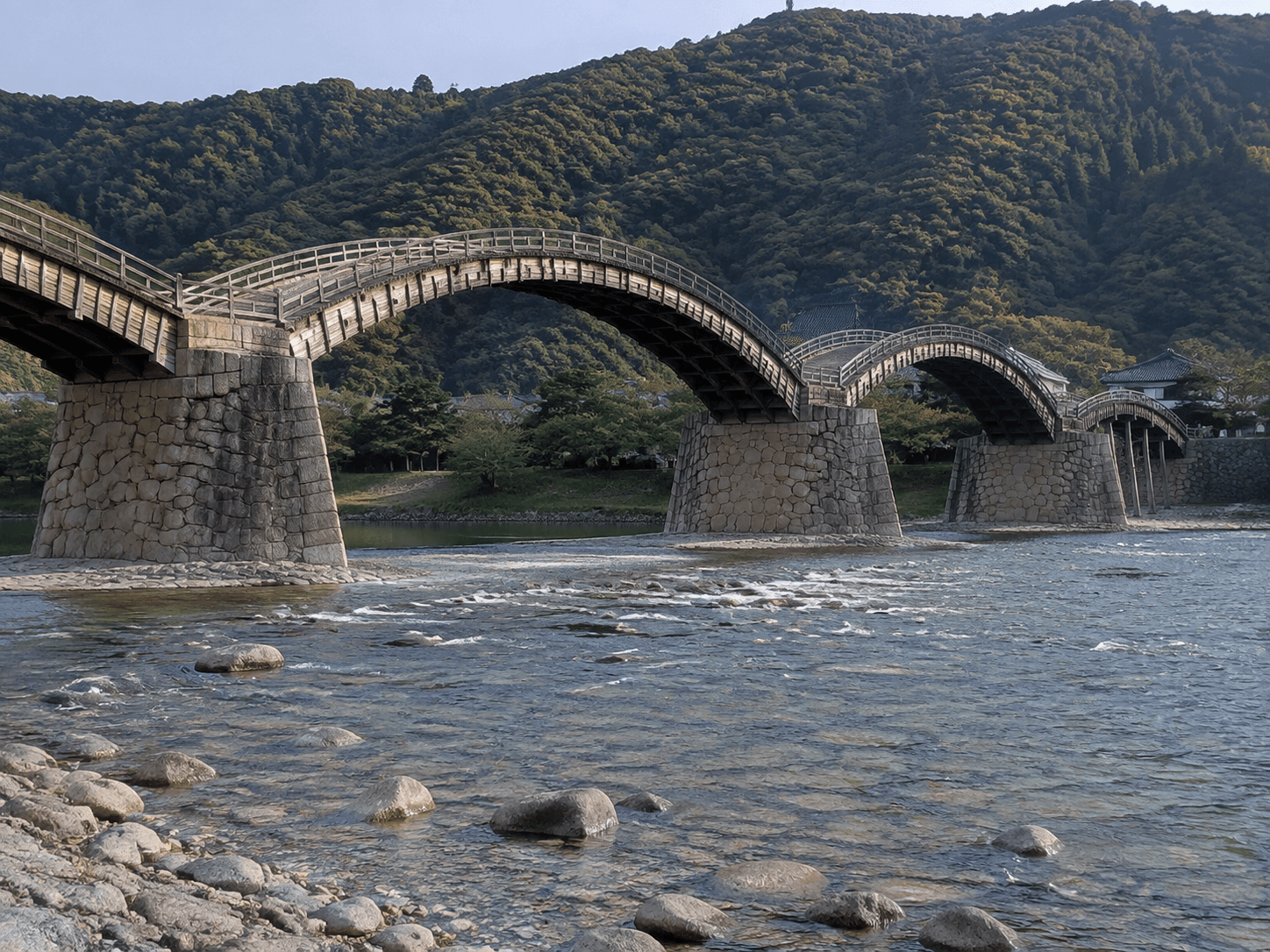
Kintaikyo(Iwakuni)industrial heritage / Eastern area / Place of Scenic Beauty / 1673
A wooden bridge of five arches, put together with almost no nails.
Dannoura(Shimonoseki)garden / park / Western area
The site of the last battle between the Minamoto and the Taira. The currents of the Kanmon Strait decided it.
Tsunoshima(Shimonoseki)industrial heritage / Western area
A bridge across an emerald sea. An island of lighthouses and fishing.
Akiyoshido(Mine)nature / scenery / Central area / Special Natural Monument / Natural Monument
One of the largest limestone caves in Japan, and the largest karst plateau.
Tsunoshima Bridge(Shimonoseki)industrial heritage / Western area / 2000
One thousand seven hundred and eighty metres across an emerald sea. Made famous by television advertisements.
Hagi(Hagi)historic townscape / Kitaura (Hagi) / Preservation District for Traditional Buildings / UNESCO World Heritage (Cultural) / UNESCO World Heritage
The layout of the samurai quarter survives as it was in the Edo period. It produced the men of the Restoration.
Motonosumi(Nagato)nature / scenery / Western area
One hundred and twenty-three torii run from the cliff down to the sea.
Karato Market(Shimonoseki)historic townscape / Western area
It handles more pufferfish than anywhere in Japan. At weekends sushi stalls line the hall.
Yuda Onsen(Yamaguchi)hot spring / Central area
Said to have been found by a white fox. The birthplace of Nakahara Chuya.
Nagato Yumoto(Nagato)hot spring / Western area / 1427
Along the Otozure river. The whole town worked together to remake its townscape.
Shimonoseki Fugu(Shimonoseki)historic townscape / Western area
Here fugu is called fuku. Ito Hirobumi is said to have lifted the ban on eating it.
Kozan Park(Yamaguchi)garden / park / Central area / National Treasure / Historic Site
One of the three finest pagodas of Japan, and the summit of Ouchi culture.
Iwakuni White Snake(Iwakuni)museum / theatre / Eastern area / Natural Monument
A rare case anywhere in the world of albino Japanese rat snakes establishing a population.
Traditional Crafts
Three crafts hold national designation: Hagi ware, Ouchi lacquerware, and Akama inkstones.
In the world of tea there is a saying: first Raku, second Hagi, third Karatsu. With use, tea seeps into the crackle of the glaze on Hagi ware and the colour changes. This is called the seven transformations of Hagi. It is said to have been started by potters who came from the Korean peninsula after the Bunroku-Keicho campaigns.
More: VILLAGE Journal vol.14 — The colour changes the more you use it(リンク先は現在公開されていません)
More from This Prefecture
See all Yamaguchi articles ← All 47 prefectures
Sources: Yamaguchi Prefecture, City of Shimonoseki, City of Hagi, City of Nagato, City of Iwakuni, City of Hofu, Agency for Cultural Affairs, Association for the Promotion of Traditional Craft Industries — Value Village editorial team