Niigata: Local Specialties, Souvenirs, Shrines & Temples, Sightseeing | Japan 47 Prefecture Guide
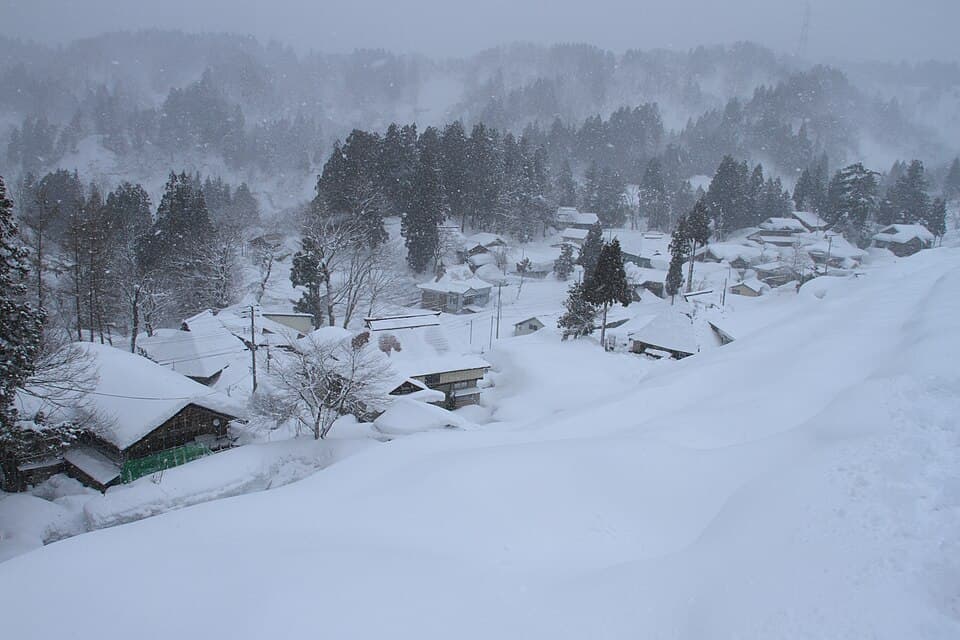
Almost everything Niigata is known for can be explained by snow and rice. The food, the sake and the crafts alike.
Local Specialties
Rice yields here are among the highest in Japan. The plain was made by draining lagoons and holding back the floods of the Shinano river. It was not good land to begin with. It was made into good land.
Niigata has more sake breweries than any other prefecture. There is rice, there is snowmelt water, and the winter is long and cold. Every condition for slow, cold fermentation is in place.
Hegi soba is buckwheat bound with funori seaweed. It came about because wheat grew poorly in the hills and the kitamaebune brought seaweed in.
Souvenirs
Sasa-dango is mugwort dumpling wrapped in bamboo grass. A preserved food that uses the antibacterial property of the leaf, and said to have been carried as rations by Uesugi Kenshin.
Kaki-no-tane began in Niigata. The story goes that in the Taisho era a maker crushed his oval rice-cracker die, used it anyway, and the warped shape resembled a persimmon seed.
And sake. A small 720ml bottle travels.
Sacred Sites | Shrines & Temples
34 shrines and temples worth knowing in Niigata.
Yahiko Jinja(Yahiko)Shinto shrine / Ichinomiya (first shrine) of Echigo Province / Chuetsu / Blessings: good harvests, good fortune, mountain worship
Its deity is said to have taught the people of Echigo how to grow rice and make salt. Rice and salt: the sake and the preserved foods of this land both rest on those two. Worship here is two bows, four claps, one bow, the same form as at Izumo Taisha and Usa Jingu.
Kasugayama Jinja(Joetsu)Shinto shrine / Joetsu / Blessings: victory, study and exams
It enshrines Uesugi Kenshin. Built on the site of his castle at Kasugayama, it also keeps the Bishamondo where Kenshin worshipped Bishamonten.
Sado Kokubunji(Sado)Buddhist temple / Historic Site / Sado / Blessings: warding off misfortune
Sado has a history of religious figures being exiled here, Dogen and Nichiren among them, and it holds a stratum of belief unlike the mainland.
Hakusan Jinja(Niigata)Shinto shrine / Kaetsu / Blessings: love and relationships, warding off misfortune
The tutelary shrine of Niigata, at the heart of a port town that opened out at the mouth of the Shinano river.
Kokujoji(Tsubame)Buddhist temple / Chuetsu / Blessings: warding off misfortune
Held to be the oldest temple in Echigo. Gogo-an, where Ryokan lived for years, still stands on the mountain.
Myosenji(Sado)Buddhist temple / Important Cultural Property / Sado / Blessings: warding off misfortune
It has the only five-storey pagoda on Sado. Said to have been founded by a disciple who followed Nichiren into exile.
Yahikosan Goshinbyo(Yahiko)Shinto shrine / Chuetsu / Blessings: mountain worship
At the 634-metre summit of Mount Yahiko. The inner shrine enshrines the deity and his consort.
Omoi no Ishi(Yahiko)Utaki (Ryukyuan sacred grove) / Chuetsu / Blessings: good fortune
A stone you lift while holding your wish in mind. If it feels light, the wish is said to be granted.
Myosenji Gojunoto(Sado)Buddhist temple / Important Cultural Property / Sado / Blessings: warding off misfortune
The only five-storey pagoda on Sado, said to be modelled on the pagoda at Nikko Tosho-gu.
Konponji(Sado)Buddhist temple / Sado / Blessings: rebirth and renewal
Built where Nichiren lived during his exile on Sado.
Sado Kokubunji(Sado)Buddhist temple / Historic Site / Sado / Blessings: warding off misfortune
A provincial temple was established on the island, proof that Sado mattered from early times.
Hakusan Hime Jinja(Nagaoka)Shinto shrine / Chuetsu / Blessings: safe voyages
The tutelary shrine of a kitamaebune port of call. Many votive ship paintings have been dedicated here.
Aoshi Jinja(Nagaoka)Shinto shrine / Chuetsu / Blessings: victory
It enshrines the Makino, lords of the Nagaoka domain, and is known for the cherry blossom of Yukyuzan Park.
Gogoan(Tsubame)Buddhist temple / Chuetsu / Blessings: study and exams
The hermitage where Ryokan lived for twenty years, known for his letter on how to meet calamity.
Fujimoto Jinja(Murakami)Shinto shrine / Kaetsu / Blessings: victory
It enshrines the Naito, lords of the Murakami domain. The centre of a castle town and a salmon town.
Matsuo Jinja(Tokamachi)Shinto shrine / Important Cultural Property / Chuetsu / Blessings: mountain worship
A thatched hall standing deep in the mountains, an Important Cultural Property.
Amatsu Jinja(Itoigawa)Shinto shrine / Joetsu / Blessings: love and relationships
It enshrines Nunakawa-hime, goddess of jade. Itoigawa is jade country.
Sekiyama Jinja(Myoko)Shinto shrine / Joetsu / Blessings: mountain worship
It worships Mount Myoko and preserves a fire festival.
Kota Jinja(Joetsu)Shinto shrine / Ichinomiya (first shrine) of Echigo Province / Joetsu / Blessings: love and relationships
One of the shrines claiming to be first of Echigo Province. It stands near where Shinran came ashore.
Rinsenji(Joetsu)Buddhist temple / Joetsu / Blessings: study and exams, victory
The temple where Uesugi Kenshin studied from the age of seven. A plaque on the gate reads Dai-ichi-gi, said to be in his own hand.
Hachimangu (Sanjo)(Sanjo)Shinto shrine / Chuetsu / Blessings: victory, business prosperity
The tutelary shrine of a town of metalworking.
Zuiunji(Agano)Buddhist temple / Kaetsu / Blessings: warding off misfortune
One of the Zen temples of Echigo.
Suwa Jinja (Shibata)(Shibata)Shinto shrine / Kaetsu / Blessings: warding off misfortune
The tutelary shrine of Shibata, known for its daiwa float festival.
Futara Jinja(Ojiya)Shinto shrine / Chuetsu / Blessings: good harvests
The tutelary shrine of Ojiya chijimi country, and of a place that holds bull-locking contests.
Rengebuji(Sado)Buddhist temple / Important Cultural Property / Sado / Blessings: warding off misfortune
Said to have been founded by Kukai. A temple of hydrangeas.
Hakusan Jinja (Niigata)(Niigata)Shinto shrine / Kaetsu / Blessings: love and relationships
The tutelary shrine of Niigata, long the guardian of the mouth of the Shinano river.
Hotokusan Inari(Nagaoka)Shinto shrine / Chuetsu / Blessings: business prosperity
A great hall looking out over the Echigo plain, known for its candle festival in November.
Koto Jinja(Sekikawa)Shinto shrine / Kaetsu / Blessings: mountain worship
It worships Mount Kousagi.
Nunagawahime(Itoigawa)Utaki (Ryukyuan sacred grove) / Joetsu / Blessings: love and relationships
Jade country. The Hime river takes its name from Nunakawa-hime.
Kasugayama Jinja(Joetsu)Shinto shrine / Joetsu / Blessings: victory
It enshrines Uesugi Kenshin, standing on the site of Kasugayama Castle.
Hoshitoge(Tokamachi)Utaki (Ryukyuan sacred grove) / Chuetsu / Blessings: good harvests
The water of the terraced fields catches the morning sun. The custom of enshrining a mountain deity for each field survives.
Iwafune Jinja(Murakami)Shinto shrine / Kaetsu / Blessings: safe voyages
The origin of the place name Iwafune. An old shrine of the salmon town.
Sekiyama(Myoko)Shinto shrine / Joetsu / Blessings: mountain worship
It worships Mount Myoko, and preserves the staff dance of the mock yamabushi.
Daizen Jinja(Sado)Shinto shrine / Sado / Blessings: the performing arts
More than thirty Noh stages survive on Sado, the island to which Zeami was exiled.
Sightseeing
Sado Gold Mine is a UNESCO World Heritage Site. Breakdown: historic townscape 3, hot spring 1, nature / scenery 4, industrial heritage 3. 15 places to see in Niigata.
Sado Gold Mine(Sado)industrial heritage / Sado / Historic Site / UNESCO World Heritage (Cultural) / UNESCO World Heritage / 1601
It underpinned the finances of the Edo shogunate. Hand-cut tunnels and the split peak of Doyu remain.
Tarai Bune(Sado)nature / scenery / Sado
Tubs for gathering wakame and abalone among the rocks. Visitors can row them too.
Echigo-Tsumari Art Field(Tokamachi)festival / event / Chuetsu / 2000
Artworks scattered through the hill villages. Terraced fields and empty houses are the stage.
Kiyotsu Gorge(Tokamachi)nature / scenery / Chuetsu / Place of Scenic Beauty / Natural Monument
One of the three great gorges of Japan. Columnar jointing reflects in the water mirror inside the tunnel.
Ponshukan(Niigata)historic townscape / Kaetsu
You can taste sake from 93 breweries across the prefecture. Niigata has more sake breweries than anywhere in Japan.
Hoshitoge Rice Terraces(Tokamachi)nature / scenery / Chuetsu
Two hundred paddies catching the morning sun. One of the hundred finest terraced fields in Japan.
Mt. Yahiko(Yahiko)nature / scenery / Chuetsu
A view over the Echigo plain and the Japan Sea, with the inner shrine at the summit.
Nagaoka Fireworks(Nagaoka)festival / event / Chuetsu / 1946
It began as a memorial to those killed in the war. The Shosanshakudama and the Phoenix rise over the river.
Tsuiki Copperware(Tsubame)industrial heritage / Chuetsu / Important Intangible Cultural Property
A single sheet of copper is hammered into a vessel. The town also makes metal cutlery.
Ushi no Tsunotsuki(Ojiya)festival / event / Chuetsu / Important Intangible Folk Cultural Property
No winner is declared; every bout ends in a draw. It appears in the novel Hakai.
Echigo-Yuzawa(Yuzawa)hot spring / Chuetsu
The setting of Kawabata Yasunari's Snow Country. The hot spring on the far side of the tunnel.
Shiobiki Sake(Murakami)historic townscape / Kaetsu
Salmon hung under the eaves. The Murakami way is to leave part of the belly uncut.
Toki Forest Park(Sado)museum / theatre / Sado / Special Natural Monument / Natural Monument
Japan's wild crested ibis died out, and reintroduction began from here.
Teradomari Fish Market(Nagaoka)historic townscape / Chuetsu
The Ameyoko of fish. You can eat grilled seafood standing at the counter.
Akashi Chirimen(Tokamachi)industrial heritage / Chuetsu
A summer silk given its crisp hand by tightly twisted thread.
Traditional Crafts
Sixteen crafts hold national designation, behind only Tokyo (18) and Kyoto (17).
Ojiya chijimi and Echigo jofu were inscribed on the UNESCO Intangible Cultural Heritage list in 2009. The process includes yuki-zarashi: laying the woven cloth out on early spring snow to whiten it.
Then Tsubame-Sanjo. It began with Japanese nails and moved on to sickles, knives and cutlery, but it has been hammering metal for four hundred years.
More: VILLAGE Journal vol.33 — Sixteen crafts: cloth, blades and paulownia(リンク先は現在公開されていません)
More from This Prefecture
See all Niigata articles ← All 47 prefectures
Sources: Ministry of Agriculture, Forestry and Fisheries, National Tax Agency (Survey of the Sake Brewing Industry), Niigata Prefecture, City of Sado, Yahiko Jinja, Agency for Cultural Affairs, Association for the Promotion of Traditional Craft Industries — Value Village editorial team