Aichi: Local Specialties, Souvenirs, Shrines & Temples, Sightseeing | Japan 47 Prefecture Guide
Aichi held both a large market, Nagoya, and a thoroughfare, the Tokaido. Its food and its crafts can both be explained from those two.
Local Specialties
Hatcho miso is a soybean miso made from soybeans and salt only, with no rice or barley koji. It is laid down in great wooden vats, weighted with stones stacked flat, and left for two years or more.
Nagano's miso uses cold to ferment slowly. Aichi's hatcho miso does the opposite, maturing over a long time in a warm, humid climate. That is why it uses no koji. The same word, miso, and two entirely different methods, each fitted to its climate.
This dark miso is what makes Nagoya food: miso katsu, miso nikomi udon, dote-ni. Cabbage, butterbur and shiso yields also rank high nationally.
Souvenirs
Uiro is rice flour and sugar, steamed. Selling it at Nagoya station made it known across Japan.
Hatcho miso, prawn crackers, tenmusu. And a Tokoname teapot, fired from iron-rich clay, which changes colour the more you use it.
Sacred Sites | Shrines & Temples
Tsushima Jinja is the head shrine of Japan's Tsushima and Tenno shrines (about 3,000 shrines). 29 shrines and temples worth knowing in Aichi.
Atsuta Jingu(Nagoya)Shinto shrine / Important Cultural Property / Owari / Blessings: victory, warding off misfortune, good fortune
It enshrines the Kusanagi sword, one of the three imperial regalia. A great camphor said to be over a thousand years old stands in its grounds, and a deep forest survives in the middle of the city. Nobunaga prayed here for victory before Okehazama, and the Nobunaga wall he dedicated after winning still stands.
Toyokawa Inari(Toyokawa)Buddhist temple / Counted among the Three Great Inari Shrines / Higashi-Mikawa / Blessings: business prosperity, wealth
It carries the name Inari but is not a shrine: it is a Soto Zen temple. A rare case of a temple that kept enshrining Inari even after the separation of Shinto and Buddhism. Countless fox figures stand at the Reikozuka behind it.
Osu Kannon(Nagoya)Buddhist temple / Owari / Blessings: good fortune, study and exams
Its gate town became a shopping arcade as it stood. Also known for the Osu Bunko, a collection of classical texts.
Tsushima Jinja(Tsushima)Shinto shrine / Important Cultural Property / Owari / Head shrine of Tsushima and Tenno shrines (about 3,000 shrines) / Blessings: warding off misfortune
The head shrine of all Tsushima and Tenno shrines in Japan. Its faith quiets epidemic disease, and the Owari Tsushima Tenno festival is an Important Intangible Folk Cultural Property.
Masumida Jinja(Ichinomiya)Shinto shrine / Ichinomiya (first shrine) of Owari Province / Owari / Blessings: warding off misfortune, business prosperity
First shrine of Owari Province. The city name Ichinomiya comes from this shrine being the ichinomiya.
Inuyama Naritasan(Inuyama)Buddhist temple / Owari / Blessings: road safety, warding off misfortune
A branch of Naritasan Shinshoji, known for blessings for road safety.
Nobunaga-bei(Nagoya)Shinto shrine / Important Cultural Property / Owari / Blessings: victory
The wall Nobunaga dedicated in thanks for his victory at Okehazama. One of the three great earthen walls of Japan.
Kusanagi no Tsurugi(Nagoya)Shinto shrine / Owari / Blessings: victory
One of the three imperial regalia. It is the sacred body of Atsuta Jingu and is never shown.
Reikozuka(Toyokawa)Buddhist temple / Higashi-Mikawa / Blessings: business prosperity
Countless dedicated fox figures stand in rows. It carries the name Inari but is a Soto Zen temple.
Sanko Inari Jinja(Inuyama)Shinto shrine / Owari / Blessings: love and relationships, wealth
At the foot of Inuyama Castle. Known for heart-shaped votive tablets and coin washing.
Fukagawa Jinja(Seto)Shinto shrine / Important Cultural Property / Owari / Blessings: business prosperity
Adjoining it is a shrine to Kato Shirozaemon Kagemasa, the founder of Seto ware.
Kojakuji(Toyota)Buddhist temple / Nishi-Mikawa / Blessings: warding off misfortune
Maples planted by an abbot grew into what is now a famous place for autumn colour.
Nittaiji(Nagoya)Buddhist temple / Owari / Blessings: warding off misfortune
It enshrines relics of the Buddha given by Thailand. The only temple in Japan belonging to no sect at all.
Nagoya Toshogu(Nagoya)Shinto shrine / Owari / Blessings: victory
A Toshogu built by the Owari Tokugawa.
Chiryu Jinja(Chiryu)Shinto shrine / Important Cultural Property / Nishi-Mikawa / Blessings: safe childbirth, road safety
The tutelary shrine of a Tokaido post town. Its tahoto pagoda is an Important Cultural Property, a trace of the old fusion of Shinto and Buddhism.
Arako Kannon(Nagoya)Buddhist temple / Important Cultural Property / Owari / Blessings: warding off misfortune
Its tahoto pagoda is the oldest building in the city of Nagoya. It holds more than a thousand Enku Buddhas.
Konomiya(Inazawa)Shinto shrine / Owari / Blessings: warding off misfortune
Known for its naked festival, in which thousands of men in loincloths press in to touch the chosen man.
Oagata Jinja(Inuyama)Shinto shrine / Ninomiya (second shrine) of Owari Province / Owari / Blessings: safe childbirth, love and relationships
A guardian deity of women. The Honen festival is held here.
Tagata Jinja(Komaki)Shinto shrine / Owari / Blessings: safe childbirth, good harvests
Known for its Honen festival, an old form of rite praying for good harvests and many descendants.
Jimokuji(Ama)Buddhist temple / Important Cultural Property / Owari / Blessings: warding off misfortune
One of the four Kannon of Owari. Its south gate is said to have been given by Minamoto no Yoritomo.
Ryusenji (Nagoya)(Nagoya)Buddhist temple / Owari / Blessings: warding off misfortune
One of the four Kannon of Owari. It guards the demon gate of Nagoya Castle.
Kasadera Kannon(Nagoya)Buddhist temple / Owari / Blessings: love and relationships
One of the four Kannon of Owari, with a legend of a girl who covered the figure with her hat and was seen and married by the lord.
Wakamiya Hachimansha(Nagoya)Shinto shrine / Owari / Blessings: warding off misfortune
The tutelary shrine of Nagoya. Floats move through the streets for the Wakamiya festival.
Daijuji(Okazaki)Buddhist temple / Important Cultural Property / Nishi-Mikawa / Blessings: rebirth and renewal
The funerary temple of the Matsudaira and Tokugawa. The town was laid out so that Okazaki Castle is seen dead ahead from the main hall.
Sanage Jinja(Toyota)Shinto shrine / Nishi-Mikawa / Blessings: warding off misfortune
It has the unusual custom of dedicating left-handed sickles.
Ohama Teramachi(Hekinan)Buddhist temple / Nishi-Mikawa / Blessings: rebirth and renewal
Seven temples gathered into a small block.
Yoshida Jinja(Toyohashi)Shinto shrine / Higashi-Mikawa / Blessings: fire protection, warding off misfortune
Held to be the birthplace of tezutsu hanabi. A pillar of fire rises from a tube held in the arms.
Horaiji(Shinshiro)Buddhist temple / Important Cultural Property / Higashi-Mikawa / Blessings: mountain worship
You climb 1,425 stone steps. A Toshogu built by Tokugawa Iemitsu stands alongside.
Sanganesan(Nishio)Utaki (Ryukyuan sacred grove) / Nishi-Mikawa / Blessings: rebirth and renewal
A mountain looking down on Mikawa Bay, with memorial towers standing in rows.
Sightseeing
Inuyama-jo and Osu Bunko holds National Treasures. Breakdown: castle 3, historic townscape 4, nature / scenery 1, industrial heritage 2. 15 places to see in Aichi.
Kamezaki Shiohi(Handa)festival / event / Nishi-Mikawa / UNESCO Intangible Cultural Heritage
The floats are hauled down onto the beach. UNESCO Intangible Cultural Heritage.
Inuyama-jo(Inuyama)castle / Owari / National Treasure / 1537
A surviving keep, and a National Treasure. It stands on a cliff above the Kiso river.
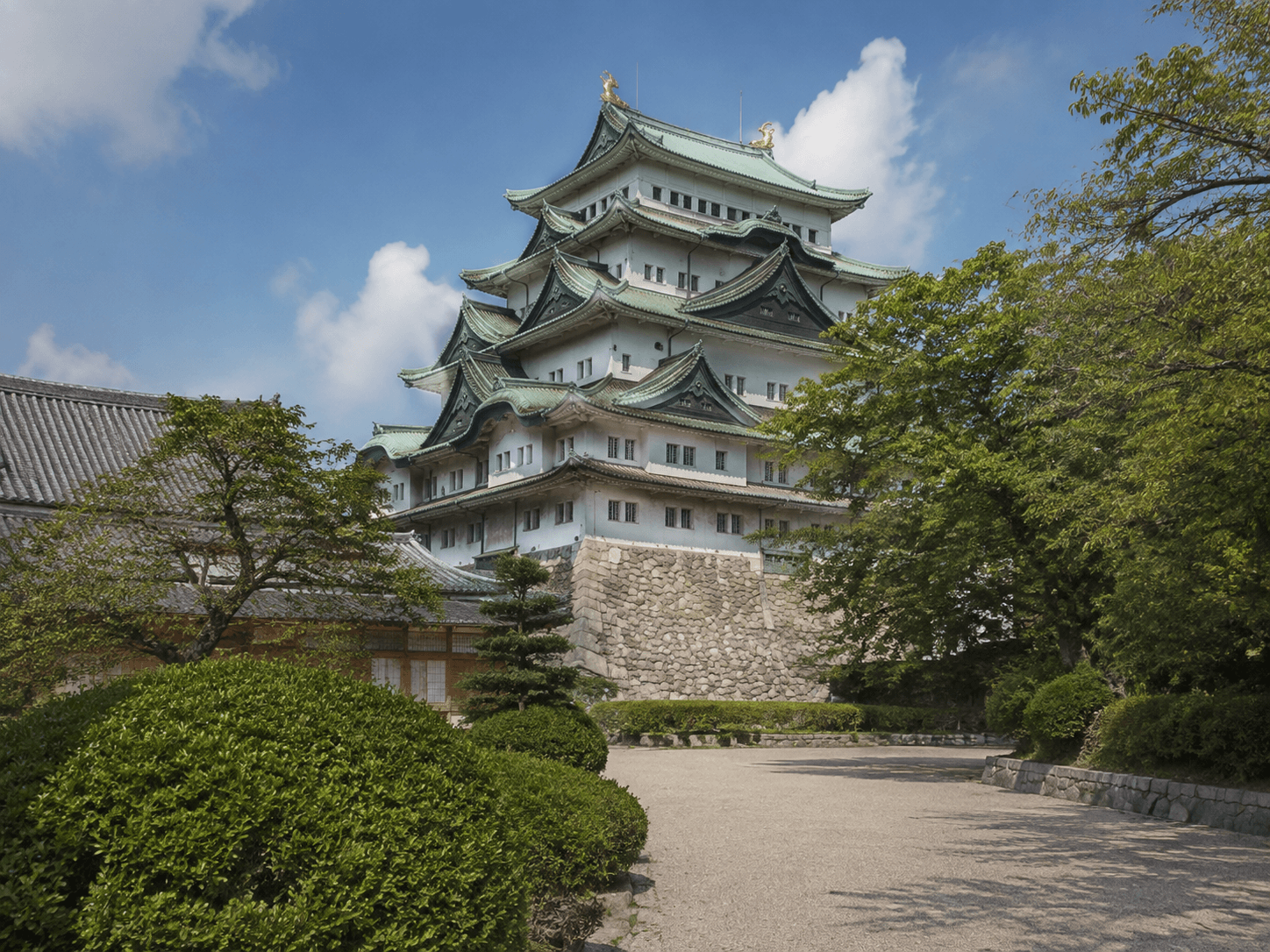
Nagoya-jo(Nagoya)castle / Owari / Special Historic Site / Historic Site / 1612
Known for its golden shachihoko. The Honmaru palace has been reconstructed.
Tatsuki Jinja(Okazaki)castle / Nishi-Mikawa / 1452
The birthplace of Ieyasu. Hatcho miso warehouses stand nearby.
Osu Bunko(Nagoya)museum / theatre / Owari / National Treasure
It holds classical texts including the oldest surviving manuscript of the Kojiki.
Tokoname(Tokoname)historic townscape / Nishi-Mikawa
One of the six ancient kilns of Japan. The history of the pottery trade survives on Dokanzaka, the clay-pipe slope.
Tsushima Tenno Matsuri(Tsushima)festival / event / Owari / Important Intangible Folk Cultural Property / UNESCO Intangible Cultural Heritage
Boats hung with lanterns cross the river. UNESCO Intangible Cultural Heritage.
Meiji-mura(Inuyama)museum / theatre / Owari / Important Cultural Property / 1965
Meiji-era buildings moved here and preserved, including the entrance hall of the Imperial Hotel.
Seto Kamagaki(Seto)historic townscape / Owari
Walls built from stacked kiln tools form the lanes. The town that gave the Japanese word for crockery.
Toyota Kaikan(Toyota)industrial heritage / Nishi-Mikawa
You can watch the assembly line. Just-in-time production, on the floor.
Arimatsu Shibori(Nagoya)historic townscape / Owari / Preservation District for Traditional Buildings
A town of shibori dyeing that grew up between the post stations of the Tokaido.
Korankei(Toyota)nature / scenery / Nishi-Mikawa
Maples planted by an abbot became four thousand trees of autumn colour.
Atsuta Monzen(Nagoya)historic townscape / Owari
A rice cake born of the custom of purifying yourself before worship. Hitsumabushi restaurants are close by.
Handa Canal(Handa)industrial heritage / Nishi-Mikawa
Vinegar and sake breweries line the water. Mizkan has its head office here.
Nagoya TV Tower(Nagoya)museum / theatre / Owari / Important Cultural Property / 1954
Japan's first integrated broadcast tower, designed by Naito Tachu.
Traditional Crafts
Thirteen crafts hold national designation, among them Arimatsu-Narumi shibori, Tokoname ware, Akazu ware, Seto sometsuke, Mikawa Buddhist altars, Toyohashi brushes, Nagoya Buddhist altars and Owari cloisonné.
Aichi is the only prefecture to hold two of the six ancient kilns of Japan: Echizen, Seto, Tokoname, Shigaraki, Tanba and Bizen.
More: VILLAGE Journal vol.25 — Thirteen crafts, two ancient kilns
More from This Prefecture
See all Aichi articles ← All 47 prefectures
Sources: Aichi Prefecture, City of Nagoya, City of Tokoname, City of Seto, City of Toyokawa, Agency for Cultural Affairs, Association for the Promotion of Traditional Craft Industries — Value Village editorial team